Archive
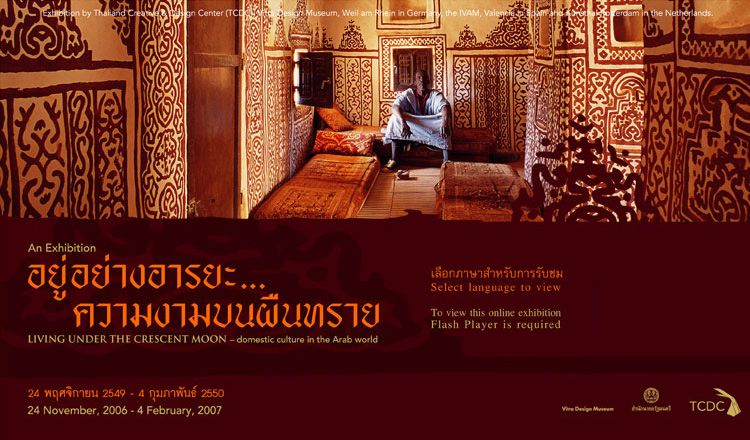
Living under the Crescent Moon – domestic culture in the Arab world อยู่อย่างอารยะ ความงามบนผืนทราย
Description
วันที่จัดแสดง : 24 พฤศจิกายน 2549 – 4 กุมภาพันธ์ 2550 สถานที่ : ห้องนิทรรศการ 2 ศูนย์สร้างสรรค์งานออกแบบ (TCDC) ชั้น 6 ดิ เอ็มโพเรียม ช็อปปิ้ง คอมเพล็กซ์ Date: 24 November 2006 - 4 February 2007 Venue: Gallery 2, TCDC, The Emporium 6th Floor
Subject
Arab / Culture / Traditional / The Middle East / Architecture / House / Building / Maghreb / tcdcarchive
Details
Released
24 November 2006
File Format
text/html
Living under the Crescent Moon – domestic culture in the Arab world อยู่อย่างอารยะ ความงามบนผืนทราย

ย้อนรอยสู่รากเหง้าของความลึกซึ้งแห่งอารยะทางความคิดและสุนทรีย์แห่งการใช้ชีวิตภายในบ้านเรือนอาหรับจากมุมที่โลกไม่เคยเห็นมาก่อน นิทรรศการบอกเล่าเรื่องราวความหลากหลายของที่อยู่อาศัยและรูปแบบการใช้ชีวิตของ 10 ประเทศ ในกลุ่มแอฟริกาตอนเหนือแถบทะเลทรายซาฮาราและตะวันออกกลางบนคาบสมุทรอาหรับผ่านพัฒนาการของ 4 วิถีชีวิต จากอารยธรรมบนผืนทรายของชนเผ่าร่อนเร่เบอร์เบอร์และเบดูอิน สู่ความงามอันเรียบง่ายแต่ลึกซึ้งของบ้านดินบริเวณเทือกเขาแอตลาส ประเทศโมร็อกโก ไปจนถึงเสน่ห์ดึงดูดของลานกลางบ้านแห่งเมืองดามัสกัส ประเทศซีเรีย และงานออกแบบบ้านอาหรับยุคศตวรรษที่ 20 ในแนวคิดโมเดิร์นนิสม์
จิตวิญญาณบ้านอาหรับ ท้องถิ่น วิถี และความงาม
เมื่อก้าวเข้าสู่บ้านอาหรับ ผู้มาเยือนจะสัมผัสได้ถึงความลึกซึ้งและความสบายที่แฝงอยู่ในการออกแบบพื้นที่ อัจฉริยภาพของอารยธรรมอาหรับได้สร้างความเข้าใจในวิถีแห่งการอยู่ดีมีสุขอย่างสอดคล้องกับท้องถิ่น อยู่อย่างอารยะ...ความงามบนผืนทราย สำรวจแนวการออกแบบในโลกอาหรับ ทั้งในแอฟริกาเหนือและตะวันออกกลาง ในบริบทที่ต่างกัน 4 แบบ ได้แก่ ที่อยู่อาศัยของชนเผ่าร่อนเร่ บ้านในชนบท สถาปัตยกรรมแบบสังคมเมืองดั้งเดิม และแบบโมเดิร์นนิสต์
ขณะที่โลกของเราต้องเผชิญกับความเสื่อมถอยทางธรรมชาติและวัฒนธรรมดังเช่นทุกวันนี้ บริบทการออกแบบในโลกอาหรับนำเสนอกระบวนทัศน์ที่เปี่ยมด้วยความคิดสำหรับอนาคต เราจะประยุกต์วิถีดั้งเดิมพร้อมกับสร้างภูมิคุ้มกันเพื่อรับมือกับความเปลี่ยนแปลงในปัจจุบันได้อย่างไร เราจะใช้ทรัพยากรที่มีอยู่ในท้องถิ่นอย่างไรให้สร้างสรรค์มากกว่าทำลาย เราจะจัดการน้ำ ทรัพยากรหลักของมนุษย์อย่างไรให้ได้ทั้งประโยชน์ใช้สอยและความอภิรมย์ เราจะออกแบบพื้นที่อยู่อาศัยอย่างไรจึงจะเกิดความสมดุลระหว่างความเป็นส่วนตัวและการอยู่ร่วมกันเป็นชุมชน
วัฒนธรรมการออกแบบของชาวอาหรับมีรากฐานมาจากการตอบโจทย์ในชีวิตจริงเกี่ยวกับการอยู่อาศัยและการดำรงชีวิตอย่างเป็นสุข บ่อยครั้งในสภาพแวดล้อมที่ทุรกันดาร ความคิดสร้างสรรค์เติบโตงอกงามขึ้นได้แม้ทรัพยากรจะมีจำกัด ทำให้วัฒนธรรมอาหรับมีสุนทรียะเฉพาะตัวที่ส่งอิทธิพลต่อศิลปะและสถาปัตยกรรมในภูมิภาคต่าง ๆ ตั้งแต่ยุโรปจนถึงเอเชีย
ภูมิปัญญานี้ได้เกิดบนพื้นฐานของ “โลกาภิวัฒน์” แบบอาหรับ โดยการเผยแพร่ของพ่อค้าชาวอาหรับที่เดินทางค้าขายไปทั่วโลกตั้งแต่ครั้งศตวรรษที่ 7 เส้นทางการค้านี้ได้กลายเป็นสื่อกลางการแลกเปลี่ยนสินค้าและวัฒนธรรม ส่งผลให้โลกอาหรับเป็นหนึ่งในศูนย์รวมของความคิดอารยธรรมโลก
INTRODUCTION
The exhibition " LIVING UNDER THE CRESCENT MOON" highlights the great differences in household cultures in Morocco, Syria and the Arabian peninsula - from the nomad tents of the Tuareg and the Bedouins via the Moroccan and Yemenite clay dwellings, magnificent houses with inner courtyards in Marrakech, Damascus or Aleppo through to 20th century buildings devised by the likes of Hassan Fathy and Studer & Hentsch. This exhibition on the homes and household interiors sheds light on a sphere of the Arab world previously unknown to us: after all, the inside of a house is always keenly guarded from the foreigner's gaze.
Although examples on display are as diverse as the cultures of the peoples inhabiting the Arab-speaking countries, they demonstrate a large number of similarities often influenced by religion. These include the great significance attached to hospitality, the important position of the woman in the home, not to mention the use of certain ornaments, colors and spatial concepts. Yet, this exhibition not only demonstrates the fascinating differences in domestic styles in Arab countries, it likewise makes apparent that designers in the Arab have to ask themselves the same questions as Western designers: What functional solutions will cater to the pattern of everyday life based on sleeping, eating, living and housework? How are decoration, form and function to be reconciled in buildings and objects? How can ornaments, colors and symbols be used to create and communicate cultural identity?
In dealing with these complexities, the rich heritage of Arab domestic cultures often reveals an astounding modernity be it in reduced basic shapes, in multi-functional solutions, in air-conditioning systems or devices to control water consumption. Many of these solutions inspired architects in the 20th century to meld traditional and modern elements to form a new domestic culture for the Arab world. Simultaneously, there is a growing trend for traditional domestic cultures in the Arab world to be ousted by an anonymous, international architecture. As such, "Living under the Crescent Moon" may document some of these domestic styles for the last time. And yet, the examples presented in the exhibition illustrate that precisely because of their rich tradition, Arab cultures of the home are ripe for their own Modern age. And not least of all: their sensuality, love of color, and abundance of design solutions can also provide inspiration for our own home interior cultures.
วิถีชีวิตร่อนเร่ (Nomads)
เปิดบ้าน 01 ตะวันออกกลาง วิมาน...จากขนสัตว์
(Station 01 MIDDLE EAST)

ชนเผ่าเร่ร่อนแห่งตะวันออกกลาง
เต็นท์ดำที่ใช้ในภูมิภาคตะวันออกกลางล้วนมีโครงสร้างพื้นฐานเหมือนกัน แต่แตกต่างกันที่รายละเอียด เช่น วิธีตรึงเต็นท์เข้ากับหลังคา หรือขนาดและลวดลายของพรมแขวนภายใน เป็นต้น เต็นท์ในตะวันออกกลางแตกต่างจากในแอฟริกาเหนือ กล่าวคือ เสาเต็นท์มีความสูงใกล้เคียงกัน แต่เสาแถวกลางจะสูงกว่าแถวอื่นเล็กน้อยเมื่อมองจากภายนอกจึงเห็นหลังคานูนเป็นรูปอานม้า ในปัจจุบันชนเผ่าเร่ร่อนเบดูอินส่วนใหญ่เดินทางอยู่ในพรมแดนประเทศของตน มีเพียงไม่กี่พันคนที่ยังคงเดินทางหลายร้อยกิโลเมตรจากทางภาคเหนือของประเทศซาอุดิอาระเบียสู่ประเทศจอร์แดน อิรักและภาคตะวันออกของซีเรีย
สำหรับเต็นท์ขนาดใหญ่ของชาวเบดูอินนี้สามารถนำขึ้นรถบรรทุกหรือรถแทร็กเตอร์ที่ใช้ขนส่งสัตว์เป็นระยะทางไกล ๆ ได้ ซึ่งเต็นท์เหล่านี้อาจมีความยาวถึง 20 เมตร และจะมีการตั้งเต็นท์ก็ต่อเมื่อตั้งใจจะปักหลักอยู่ที่เดิมเป็นเวลาหลายวันหรือหลายสัปดาห์ ขนาดของเต็นท์และเครื่องตกแต่ง เช่น พรมรองนั่ง เบาะ ฟูกนอน ถือเป็นเครื่องบ่งบอกสถานภาพและฐานะของเจ้าของ
Nomads in the Middle East
The black tents of the Middle East are all based on the same fundamental construction, but vary in details, such as how the tent is fastened to the roof or the size and patterns of the hanging carpets. Unlike many North African tents, tents in the Middle East have posts of similar lengths, making it possible to stand up throughout the tent. The row of posts in the middle is somewhat higher, so that from the outside the tent seems to have a saddle roof. Only a few thousand nomadic Bedouins still travel the hundreds of kilometers between the north of Saudi Arabia, Jordan, Iraq and eastern Syria. Most stay within the borders of their own country.
Large Bedouin tents can also be loaded onto the trucks and tractors used to transport animals over great distances today. Tents, which can be up to 20 meters long, are only pitched if the intention is to stay in the same place for a few days or weeks. Status and wealth are symbolized by the size of the tent as well as by its trappings, which include carpets to sit on, cushions and mattresses.
เต็นท์ของชาวเบดูอิน (Bedouin Tent)
เผ่าวาร์กา ประเทศอิรัก (Warqa tribe, Iraq)
ศตวรรษที่ 20 (20th century)

วาร์กา เป็นชาวเบดูอินเผ่าหนึ่งที่ใช้เต็นท์ดำเป็นที่อยู่อาศัย คำว่าเต็นท์ดำนั้นเป็นชื่อสามัญที่ใช้เรียกเต็นท์แบบเดียวกันที่มีจุดกำเนิดในตะวันออกกลางและสามารถพบเห็นได้ตั้งแต่แถบประเทศมอริตาเนียไปจรดเทือกเขาหิมาลัยซึ่งนิยมเลี้ยงแพะและแกะที่ให้ขนสำหรับนำมาทำผ้าเต็นท์ และเมื่อมีการเลี้ยงอูฐเพื่อใช้เป็นพาหนะในการเดินทางเพิ่มมากขึ้น ขนาดของเต็นท์จึงขยายใหญ่ และมีน้ำหนักมากขึ้นตามไปด้วย ในขณะเดียวกันแต่ละเผ่าก็ได้สร้างลักษณะเฉพาะของเผ่าตนลงไปในเต็นท์ เช่น ในทิเบตใช้ขนจามรีเป็นวัสดุในการทอ ในทะเลทรายอาระเบีย เต็นท์มีรูปร่างแบนเพื่อให้ทนต่อพายุทะเลทราย ส่วนในแอฟริกาเหนือหลังคาจะยกสูงตรงกลางเพื่อให้น้ำฝนไหลลงได้สะดวก
เต็นท์ดำแบ่งเป็นหลายส่วนเพื่อให้โครงสร้างรับน้ำหนักให้น้อยที่สุดผ้าเต็นท์ทำจากขนสัตว์ผืนยาวเย็บติดเป็นชิ้นเดียวกัน ส่วนมากมีสีดำจึงเป็นที่มาของชื่อ "เต็นท์ดำ" ชายเต็นท์มีผ้าผืนยาวเย็บเป็นขอบโดยรอบและมีกำแพงเตี้ย ๆ ทำจากดิน หิน หรือเสื่อกกล้อมรอบอีกชั้นหนึ่ง เต็นท์ดำในทะเลทรายอาหรับและแถบตะวันออกกลางโดยเฉพาะเผ่าวาร์กามีการประยุกต์ให้เข้ากับสภาพภูมิอากาศที่แห้งแล้ง เต็นท์เหล่านี้จึงมีลักษณะเรียบง่าย ใช้ผ้าทรงสี่เหลี่ยมผืนผ้าขึงกับเสา 5 ต้นซึ่งป้องกันแสงแดดที่ร้อนระอุได้เป็นอย่างดี แต่ละเต็นท์จะมีขนาดใหญ่เพียงใดขึ้นอยู่กับความสำคัญของเจ้าของ สำหรับผ้าด้านนอกทอจากขนแพะผสมขนอูฐจำนวน 6 ผืน ส่วนด้านในมีแถบผ้าแคบ ๆ เย็บติดตามแนวขวางเพื่อช่วยยึดเนื้อผ้าให้แน่นหนา ตรงปลายแถบผ้าแต่ละแถบเกี่ยวไว้ด้วยตะขอไม้ผูกเชือกขนแกะเส้นยาวที่ช่วยตรึงผ้าเต็นท์ให้ตึงและมั่นคง
ภายในแบ่งเป็น 2 ส่วนโดยใช้ม่านกั้น เจ้าบ้านฝ่ายชายใช้พื้นที่ซีกซ้ายเป็นที่รับแขกบนพรมรองนั่ง อีกซีกหนึ่งสำหรับผู้หญิงไว้ดูแลงานบ้านและครอบครัว เตาไฟ กระบอกน้ำหนังแพะ และเครื่องใช้ในครัวต่าง ๆ เก็บไว้ทางซีกขวา สำหรับการตั้งและเก็บเต็นท์นั้นถือเป็นหน้าที่ของผู้หญิง
The Warka, who belong to the Bedouin tribe, use a black tent. The generic term black tent relates to the same type of tent found from Mauritania to the Himalayas, which originates in the Middle East. It is there that the domestication of goat and sheep, whose hair is used to make the covering, took place. With the domestication of the dromedary as a pack animal, the black tent really expanded, as its size and therefore weight could be increased. Meanwhile, each of the peoples has contributed their own characteristics. For example, in Tibet, yak hair is used for the covering; in the Arabian deserts the tent is flattened to resist sand storms, whilst in North Africa the roof becomes more pointed to allow the rain to drain away.
The black tent has several bays. The vertical load-bearing structure is reduced to a minimum. The covering is composed of long bands of animal hair sewn together. It is normally black in color, hence the name "black tent". The tent is surrounded by bands of cloth pinned to the edge of the covering and also by low walls of earth or stone or reed matting. The tent of the Arabian deserts and the Middle East, notably the Warka tent, is considered to be particularly well adapted to an arid climate. Very simple in appearance, a rectangular cloth is stretched over five poles, giving excellent protection from the violent sun. The number of bays depends on the importance of the owner. The covering is made of six bands of fabric in a mix of goat and camel hair. On the inner surface, narrow strips of cloth are sewn crossways to hold the fabric. Tension is created by wooden hooks with long woolen cords attached to the ends of these strips to secure the tent. The interior of the tent is divided in two by a curtain. The left side is where the master receives his guests and seats them on carpets. The women's side shelters family life. The hearth, the goatskin bottles of water and various utensils are on this side. The black tent is pitched and taken down by the women.
เปิดบ้าน 02 แอฟริกาตอนเหนือ ออกแบบบ้านพกพาตามดินฟ้าอากาศ
(Station 02 NORTH AFRICA)

ชนเผ่าเร่ร่อนแห่งทะเลทรายซาฮารา
เมื่อหลายศตารรษมาแล้ว ครั้งชาวอาหรับนาศาสนาอิสลามมาเผยแพร่ในหมู่ชาวแอฟริกาตอนเหนือทำให้ชนเผ่าเบอร์เบอร์ซึ่งเคยตั้งรกรากเป็นหลักแหล่งได้หันมาเดินทางเร่รอนเลี้ยงสัตว์ในทะเลทรายซาฮารา ชาวเบอร์เบอร์เหล่านี้ได้รับเอาเต็นท์ดำของชาวอาหรับเร่ร่อนมาตัดแปลงและประยุกต์ใช้หลายรูปแบบ เช่น เต็นท์ของชนเผ่ากึ่งเร่ร่อนแถบเทือกเขามิดเดิลแอตลาสในประเทศโมร็อกโกจะมีหลังคาโค้งสูงตรงกลางซึ่งเป็นผลจากการวางคานส้นขวางบนเสาสูง 1 หรือ 2 ต้น ส่วนชาวเบอร์เบอร์เผ่าทวาเร็กทางตอนใต้ทะเลทรายชาฮาราจะอาศัยอยู่ในเต็นท์ที่ทำจากหนัง ต้นกกและต้นหญ้า เป็นต้น
ในคริสต์ศตวรรษที่ 20 ชนเผ่าเร่ร่อนต้องหันมาตั้งบ้านเรือนเป็นหลักแหล่งหรือย้ายเข้าไปอยู่ในเมืองด้วยหลายสาเหตุประการแรกเกิดจากการที่รัฐต่างๆ ได้กำหนดพรมแดนระหว่างกันเป็นการถาวรซึ่งเท่ากับเป็นการจำกัดพื้นที่เลี้ยงสัตว์ของชนเผ่าเร่ร่อน สาเหตุที่สองคือการขยายตัวของพื้นที่แห้งแล้งในทะเลทรายชาฮารา สาเหตุที่สามคือการเลี้ยงสัตว์มากเกินควรในพื้นที่ที่เหลือ และสุดท้ายได้แก่การที่รัฐบาลดำเนินโครงการสร้างที่อยู่อาศัยอย่างเป็นหลักแหล่งให้แก่ชนเผ่าเร่ร่อน สำหรับครอบครัวกึ่งเร่ร่อนนั้นจะออกเดินทางในหน้าร้อนซึ่งขาดแคลนทั้งน้ำและทุ่งหญ้าสำหรับเลี้ยงสัตว์ คนเหล่านี้จะปักหลักไม่ไกลจากบ่อน้ำและหมู่ต้นปาล์ม โดยสร้างบ้านด้วยใบปาล์ม เศษผ้าและสังกะสี ในทุกวันนี้สามารถพบเห็นเต็นท์ดำได้เป็นครั้งคราวเท่านั้นและส่วนมากอยู่ในสภาพทรุดโทรม
Nomads in the Sahara
Centuries ago, when North Africa was converted to Islam by the Arabs, Berber tribes who were originally sedentary began to wander through the vast reaches of the Sahara as berdsmen. They adopted the traditional black tent of the nomadic Arabs of the Middle East and modified it in various ways. For example, the tent of the semi-nomadic tribes of the Middle Atlas Mountains in Morocco has a roof with a high arch in the middle; a form which results from placing a short cross-beam on top of one or two longer poles. Members of the Tuareg Berbers in the south Sahara live in tents made of leather, reeds and grass.
During the 20th century, for a variety of reasons many nomads were forced to become sedentary or move to the cities. First, states established borders which limited grazing areas; second, the Sahara s arid belt grew; third, many other areas were over-grazed; and finally, there were a number of state programs for the permanent settlement of nomads. Semi-nomadic families move about in the summer when there is a shortage of water and pasture land. They stay near wells and palm groves and build simple dwellings of palm leaves, pieces of cloth and corrugated iron. Nowadays black tents are only seen occasionally and they are often in poor condition.
เต็นท์ชนเผ่าเร่ร่อน (Nomad Tent)
เมืองอะดราร์ ประเทศมอริตาเนีย (Adrar, Mauritania)
คริสต์ศตวรรษที่ 20 (20th century)

ประเทศมอริตาเนียคือดินแดนฝั่งตะวันตกของทะเลทรายซาฮาราอยู่ระหว่างภาคใต้ของประเทศโมร็อกโกกับภาคเหนือของประเทศเซเนกัล พวกมัวร์ซึ่งเป็นชาวอาหรับที่พิชิตดินแดนตั้งแต่แอฟริกาเหนือไปจนถึงสเปนเรียกตัวเองว่าชาวเร่ร่อนผิวขาว เพื่อแสดงถึงความแตกต่างจากพวกมัวร์ผิวดำเจ้าถิ่นที่ปักหลักทำอาชีพกสิกรรม
เต็นท์ของพวกมัวร์ตั้งบนพื้นที่ค่อนข้างราบเรียบ โครงเต็นท์ประกอบด้วยเสาคู่แรกจำนวน 2 ต้น ยาว 3.5 และ 4 เมตร เส้นผ่าศูนย์กลาง 8-10 เชนติเมตร ทำจากไม้ซึ่งนำเข้าจากประเทศมาลี เสาวางอยู่บนดินอย่างง่าย ๆ และบรรจบกันที่เกือบสุดปลายเสา ด้านบนคลุมด้วยผ้าซึ่งทำหน้าที่ตรึงเสาให้อยู่กับที่ ยอดเต็นท์ไม่มีการเจาะช่องรับแสงสว่างแต่อย่างใด เมื่อก่อนมีการแกะสลักเสาเต็นท์เป็นลวดลาย แต่ต่อมาเริ่มมีการใช้เสาเปลือยไร้การตกแต่งมากขึ้นเรื่อย ๆ สำหรับเสาอีกคู่หนึ่งทำหน้าที่ยกผ้าเต็นท์ขึ้นเพื่อให้เกิดช่องว่างเป็นทางเข้า เสาคู่ที่สองนี้มีความยาว 1.5 เมตรและมีเส้นผ่าศูนย์กลางยาว 5 เชนติเมตรเท่ากัน ซึ่งสามารถย้ายที่ไปมาได้ตามแต่จะต้องการให้ทางเข้าอยู่ที่ใด
สำหรับผ้าเต็นท์ที่ทอโดยผู้หญิงนั้นประกอบไปด้วยแถบผ้าขนแพะความกว้างเท่ากันจำนาน 8 ชิ้น แถบตรงกลางผ้ามีขนาดกว้างที่ได้รับการเสริมให้หนาและแข็งแรงเป็นพิเศษ ส่วนแถบผ้าตรงขอบมีขนาดแคบกว่าและทำการเปลี่ยนใหม่ทุกปี สำหรับผ้าเต็นท์ด้านกว้างนั้นขลิบขอบด้วยแถบผ้าเนื้อเดียวกับตัวเต็นท์ โดยตรึงขอบผ้าติดกันแล้วปล่อยชายระพื้นถ่วงด้วยก้อนหิน เต็นท์ด้านยาวมีม่านผ้าฝ้ายสีขาวปิดไว้เพื่อกันความร้อนแต่ปล่อยให้แสงสว่างผ่านเข้าไปในเต็นท์ได้ สำหรับภายในมีผ้าอีกผืนหนึ่งแขวนกันบริเวณเป็นสองส่วน ด้านซ้ายเป็นเขตของฝ่ายหญิง ด้านขวาเป็นของฝ่ายชายส่วนพื้นใช้เสื่อและพรมปูทับบนพื้นทราย การยึดเต็นท์สำหรับพวกมัวร์นั้นต่างจากพวกเบอร์เบอร์ตรงที่ไม่นิยมใช้แถบผ้าผูกยึดผ้าเต็นท์ แต่ใช้ตะขอไม้เย็บติดกับขอบผ้าแล้วใช้แถบหนังโยงติดกับหมุดไม้เล็ก ๆ ที่ตอกกับพื้นแทน
Mauritania refers to the region of the western Sahara south of Morocco and north of Senegal. The Moors, conquering Arabs from North Africa and Spain, call themselves El Be ih ane, the nomadic white men, as opposed to the sedentary Blacks, growers and gardeners.
Their tent is placed on relatively flat ground. The frame consists of two poles, 3.5 and 4 meters long and from 8 to 10 centimeters in diameter, made of wood imported from Mali, which are crossed near their summit. The poles are simply placed on the ground and held in their position by the fabric that they hold up, at just one point - there is no skylight at the summit. Formerly, the masts were sculpted, but little by little, undecorated poles appeared. Another pair of poles extends the opening of the tent by supporting the fabric here and there. These poles are 1.5 meters long and 5 centimeters in diameter. By moving them on the ground the opening of the tent can be varied.
The covering is composed of bands of goat hair fabric woven by the women. There are eight bands of the same width. The central band is wider and reinforced. The edging bands are narrower and renewed each year. The Moors, as opposed to the Berbers, do not use strips of fabric to tie down the covering. Wooden hooks are sewn directly onto the edge of the tent cloth along the short sides, and leather strips hook them onto little wooden pegs, which are driven into the ground. The narrow sides of the tent are closed by bands, identical to those of the tent cloth, pinned on the edge of the fabric and descending to the ground where they are held by stones. The far end of the tent is closed by a white cotton curtain which protects from the sun while allowing the light to pass through. Another hanging divides the interior into two parts, one to the left for women, the other to the right for the men. Straw mats and carpets are placed on the sandy floor.
บ้านชนบท (Rural Architecture)
เปิดบ้าน 03 มอริตาเนีย วอลเปเปอร์ที่นี่ไม่ใช้กระดาษ
(Station 03 MAURITANIA)

บ้านที่มีลานตรงกลางในเมืองวาลาตา
ประเทศมอริตาเนีย
เมืองวาลาตาเป็นแหล่งโอเอซิสอยู่บริวณขอบทะเลทรายชาฮาราซึ่งเป็นประเทศมอริตาเนียในปัจจุบัน ครั้งหนึ่งที่นี่เคยเป็นศูนย์กลางทางการค้าและวัฒนธรรมที่รุ่งเรื่องและยังเป็นจดเชื่อมต่อระหว่างแอฟริกาเหนือฝั่งตะวันออกและตะวันตก อีกทั้งเคยเป็นแหล่งค้าทอง ทาส เกลือเม็ด ผ้าไหม ทองเหลือง ทองแดง และม้า บ้านที่เมืองวาลาตาก่อด้วยอิฐโคลนตากแห้งและหินทุบ ตัวบ้านประกอบด้วยห้องหลายห้องเรียงรายรอบลานกลางบ้านซึ่งอาจมี 1 หรือ 2 ลานแล้วแต่ฐานะของเจ้าของบ้าน บ้านแต่ละหลังมีห้องรับแขกโอ่โถง ตกแต่งด้วยลวดลายฝาผนังที่มีเอกลักษณ์เช่นเดียวกับที่กำแพงรอบลานกลางบ้าน แต่แตกต่างกันที่สี โดยลวดลายภายนอกเป็นสีขาวหรือเทาบนพื้นปูนเปียกสีออกแดง ส่วนกายในบ้านเป็นลายสีแดงบนพื้นปูนสีขาว การวาดลวดลายบนผนังนี้เป็นงานของผู้หญิงโดยเฉพาะ และในปัจจุบันมีผู้หญิงเพียงไม่กี่คนที่ ยังสามารถทำหน้าที่นี้ใด้อยู่ สำหรับลวดลายบนผนังซึ่งเป็นเส้นโค้งอิสระนี้แสดงถึงรูปร่างมนุษย์ ชี้ให้เห็นว่าชีวิตของชาววาลาตาได้รับอิทธิพลจากวัฒนธรรมแอฟริกามากพอๆ กับวัฒนธรรมอาหรับ เมื่อค.ศ. 1996 องค์การยูเนสโกประกาศให้เมืองวาลาตาเป็นมรดกโลก และนับจากนั้นป็นต้นมา บ้านที่มีลานอยู่ตรงกลางหลายต่อหลายหลังก็ได้รับการบูรณะให้พ้นจากความทรุดโทรม
Courtyard Houses
Oualata
Mauritania
Oualata is an oasis on the edge of the Sahara in what is now Mauritania. It was once a flourishing center of commerce and culture, interfacing east and west North Africa. Gold, slaves, rock salt, silk, brass, copper and horses were traded here.
The houses are made of sun-dried mud bricks and broken rock. Depending on the prosperity of the family, rooms are arranged around one or two courtyards. Each house contains an imposing room where guests are received. Like the courtyard, this room is decorated with a unique style of murals. In the courtyards, the zestful white/gray ornamentation is accented by the reddish background of the plaster. In the rooms, it is just the opposite - they are a rusty red color painted on white plaster. It's only women who paint this decoration, and there are only a few in Oualata today still specialized in the task. They consider the freeform curving lines to be representations of human figures, something which calls attention to the fact that life in Oualata has been influenced as much by African as it has by Arab culture. In 1996, Oualata was added to the UNESCO world heritage list. Since then, many houses with inner courtyards have been saved from ruin.
เปิดบ้าน 04 โมร็อกโก ชุมชนปลอดภัยโดยป้อมปราสาททราย
(Station 04 MOROCCO)

คาสบาห์ในประเทศโมร็อกโกตอนใต้
ณ จุดที่เทือกเขาไฮแอตลาสทอดมาบรรจบกับดินแดนทางตอนใต้ของประเทศโมร็อกโกก่อนถึงทะเลทรายซาฮารามีหมู่บ้านรูปทรงคล้ายปราสาทป้อมปราการที่เรียกว่า คาสบาห์ หรือ คซูร์ อยู่หลายแห่งด้วยกัน หมู่บ้านเหล่านี้สร้างขึ้นในบริเวณที่มีสาขาแม่น้ำหรือโอเอซิสที่เอื้ออำนวยต่อการทำกสิกรรม ในบางถิ่นการค้าขายแบบกองคาราวานก็มีความสำคัญ และแม้ว่าอันตรายจากการสู้รบหรือการโจมตีโดยชนเผ่าเร่ร่อนจะหมดไปแล้ว แต่หมู่บ้านเหล่านี้ก็ยังคงมีกำแพงสูงล้อมรอบอยู่ คาสบาห์แต่ละแห่งมักอยู่ใต้การปกครองของครอบครัวที่พำนักอยู่ที่ปราสาทเรียกว่า ติกห์เรมต์ ซึ่งตั้งสูงเด่นอยู่เหนือหมู่บ้าน
คาสบาห์แต่ละแห่งประกอบด้วยบ้านหลายหลังปลูกอยู่ใกล้กัน แต่ละหลังสูงสองหรือสามชั้นและมีลานกลางบ้าน มีทางเชื่อมต่อกันเป็นตรอกแคบและตรอกที่เป็นทางตัน ภายในบ้านประกอบด้วยห้องแคบ ๆ เรียงรายกันอยู่รอบลานกลางบ้านซึ่งอาจมีหลังคาคลุมด้านบนมีช่องเปิดแสงขนาดไม่เกิน 2 หรือ 3 ตารางเมตร ทำให้ในบ้านมีแสงสว่างลอดเข้ามาสลัว ๆ ห้องเก็บของ คอกสัตว์และห้องครัวล้วนอยู่ที่ชั้นล่างของบ้าน ส่วนที่อยู่ของคนในบ้านและห้องรับแขกนั้นอยู่ชั้นบน ในหน้าร้อนคนในบ้านมักออกมาอยู่บนดาดฟ้าในช่วงเย็นและกลางคืน ทุกวันนี้คาสบาห์หลายแห่งอยู่ในสภาพทรุดโทรมเนื่องจากคนในหมู่บ้านจำนวนมากย้ายถิ่นฐานไปตั้งรกรากและทำงานในแถบอื่นของประเทศ
Kasbahs
South Morocco
At the point where the High Atlas and the pre-Sabaran region of south Morocco meet, there are still a large number of fortified, castle-like villages, known as kasbahs or ksour. They were built in places where a river wadi or an oasis well-permitted agriculture. Trade with caravans was also important in some places. Although warring encounters and raids by nomads are no longer a danger, these villages are still surrounded by high walls. A kasbah was usually under the control of a ruling family who lived in a kind of castle called a tighremt, which towered above the village.
The kasbah consists of two and three-story houses with inner courtyards, built very close together and accessed via narrow alleys and cul-de-sacs. Their narrow rooms are arranged around a central courtyard which sometimes has a roof. An opening of not more than two or three square meters permits a little light to enter via the courtyard. Storerooms, stables and a kitchen are located on the ground floor while the living area and a reception room are above. During the hot seasons, the inhabitants usually stay on the roof terrace in the evening and at night. Today, many kasbahs are dilapidated, as the former residents now live and work in other parts of the country.
บ้าน 05 โมร็อกโก ป้อมประกันสังคม
(Station 05 MOROCCO)

บ้านก่อด้วยอิฐโคลนแถบเทือกเขาไฮแอตลาสและเทือกเขาแอนติแอตลาส
ประเทศโมร็อกโก
หุบเขาในแถบเทือกเขาไฮแอตลาสและแอนติแอตลาสมีความสูงราว 3,000 เมตร หิมะในฤดูหนาวมักทำให้หมู่บ้านชาวเบอร์เบอร์ถูกตัดขาดจากโลกภายนอกเป็นเวลานานหลายเดือน บ้านเรือนในแถบที่ราบเชิงเขาด้านเหนือมักเป็นบ้านขนาดใหญ่ชั้นเดียว มีลานอยู่ตรงกลาง ส่วนบ้านที่บนแนวลาดของภูเขาที่สูงขึ้นไปจะปลูกเป็นแนวขั้นบันไดสลับฟันปลา ในบางแคว้นใช้อิฐโคลนตากแห้งสร้างบ้าน แต่บางแคว้นใช้ดินอัดซึ่งเรียกว่า ปิเซ สำหรับสิ่งก่อสร้างดั้งเดิมในแถบเทือกเขาไฮแอตลาส ได้แก่ อกาเดียร์ ซึ่งเป็นชื่อที่ชาวเบอร์เบอร์ใช้เรียกยุ้งฉางที่มีลักษณะเหมือนป้อมปราการนั้นมีความสำคัญมากจนเกือบจะเรียกได้ว่าเป็นสิ่งศักดิ์สิทธิ์ อกาเดียร์ตั้งอยู่บนเนินเขาที่สามารถมองเห็นได้จากหมู่บ้าน ใช้เป็นที่เก็บเสบียงอาหารสำหรับฤดูหนาวเช่นเดียวกับอาวุธและข้าวของมีค่าต่าง ๆ โดยแต่ละครอบครัวจะมีห้องเล็ก ๆ ในป้อมปราการครอบครัวละ 1 ห้อง การบริหารจัดการตลอดจนการดูแลและป้องกันอกาเดียร์เป็นหน้าที่ที่ทุกคนช่วยกันทำ ในยามสงครามชาวบ้านยังได้อาศัยอกาเดียร์เป็นที่หลบภัยอีกด้วย
Mud-Brick Buildings in the High Atlas and Anti-Atlas Mountains
Morocco
The valleys of the High-Atlas and Anti Atlas Mountains go up to about 3,000 meters high. In the winter, snow often isolates the Berber villagers from the outside world for months on end. In the flat regions on the northern slopes, the houses tend to be single-story edifices and are built around a courtyard. On the slopes in higher areas, the houses are built on terraces and villages zigzag up them. In some regions, sun-dried mud bricks are used and in other regions, houses are built of pressed earth (pise). Typical of the High Atlas Mountains is the agadir, the Berber name for a fortified storage silo which is almost considered to be holy. The agadir is located on a hill within view of the village. It is the traditional place for storing supplies for the winter as well as for weapons and valuable belongings. Each family had its own small room in this fortification which was jointly administered, guarded and maintained. In times of war, the agadir also served as a refuge.
บ้านไร่คล้ายป้อมปราการ (Fortified Farm)
หมู่บ้านไอต อิมิ ในหุบเขาไอต บูกเมซ เทือกเขาไฮแอตลาส
(Ait Imi in the Ait BouGmez Valley, High Atlas)
ประเทศโมร็อกโก (Morocco)

ไอต บูกเมซ เป็นหุบเขาลุ่มแม่น้ำลักดาร์ ในแคว้นเซ็นทรัลแอตลาสตอนบน ห่างจากเมืองมาราเคชไปทางตะวันออกราว 150 กิโลเมตร แคว้นแอตลาสตอนบนมีสภาพภูมิประเทศเป็นเทือกเขาสูงทุรกันดาร ยอดเขาที่สูงที่สุดคือยอดมะกูนซึ่งมีความสูงถึง 4,070 เมตร ชนเผ่าไอต บูกเมซ มีอาชีพเลี้ยงแกะ ปลูกข้าวสาลี ข้าวบาร์เลย์ ข้าวโพด ข้าวฟ่าง และพืชบางชนิดอยู่กลางหุบเขา บ้านไร่นี้ตั้งอยู่ที่หมู่บ้านไอต อิมิ ที่ความสูง 2,000 เมตร
ชาวไอต บูกเมซถือเป็นชาวเผ่าเบอร์เบอร์เผ่าหนึ่ง ตามธรรมเนียมโบราณ ชาวเบอร์เบอร์รวมตัวกันเป็นสาธารณรัฐ ซึ่งจะยอมรับอำนาจของสภาชาวเผ่าของตนเท่านั้น การสู้รบระหว่างเผ่าใกล้เคียงเกิดขึ้นบ่อยครั้ง ทำให้มีสภาพการดำรงชีวิตที่เสี่ยงอันตรายจึงมีความจำเป็นต้องสงวนทรัพยากรหลายอย่างไว้ใช้ในฤดูหนาวและสภาพที่ไร้ความมั่นคงอย่างถาวรนี้เห็นได้ชัดจากบ้านและยุ้งฉางที่ได้รับการพิทักษ์รักษาอย่างดี
รูปทรงของบ้านหลังนี้น่าจะได้แบบอย่างมาจากป้อมปราการของพวกโรมัน กล่าวคือ มีสิ่งก่อสร้างหลักล้อมรอบด้วยหอคอย 4 หอ กำแพงสร้างด้วยดินเหนียวผสมกรวดทุบให้แน่น ช่างก่อสร้างเรียงก้อนดินผสมสูง 80 เซนติเมตรเป็นแนวสม่ำเสมอ แล้วติดตั้งต่อกันห้าจรดท้ายเป็นมุมฉากกับด้านหน้าหรือเป็นแผ่น ๆ ขนานกับด้านหน้า ช่องเปิดบนกำแพงเป็นช่องแคบ ๆ ระยะห่างเท่ากันอยู่ระหว่างรอยต่อหัวท้ายของก้อนดินที่ใช้ทำกำแพง พื้นบ้านปูด้วยไม้กระดานอุดรอยต่อด้วยดินอัดแน่น น่าเสียดายที่อาคารบ้านเรือนในหุบเขานี้ไม่ได้รับการซ่อมแซมอย่างสม่ำเสมอ เมื่อหลังใดเกิดความเสียหายก็จะถูกทิ้ง และไม้ที่ใช้ก่อสร้างจะถูกรื้อไปสร้างบ้านใหม่ติดกับหลังเดิม
Ait Bou G mez is a valley in the Upper Central Atlas region, hollowed out by the Lakhdar wadi, about 150 km to the east of Marrakech. The upper Atlas region is an imposing, rugged chain of mountains where the highest peak, M Goun, reaches 4,070 meters. The Ait Bou G mez people raise sheep and grow wheat, barley, corn, sorghum and some vegetables in the heart of their valley. The farm house shown is situated in the village of Ait Imi at an altitude of 2,000 meters. The Ait Bou G mez belongs to the Berber group. According to ancient custom, the Berber tribes formed small "republics", each of which tolerated only the power of the assembly of their tribesmen. Fights between neighbours were frequent. Precarious living conditions, the need to put aside various reserves for winter and the permanent state of insecurity are all reflected in these fortified farms and communal granaries.
The form of this house is probably derived from the Roman fort, consisting of a central body surrounded by four towers. The walls are built in cob, a wet clayey earth mixed with pebbles and tamped in planked shuttering. The mason lays 80 centimeter high module-blocks in regular layers. These module-blocks are "installed" end-on, perpendicular to the facade or in panels, parallel to the facade. The loophole openings are slits which are regularly spaced between the module blocks laid end-on. The floors are made of beams, joists and branches covered with a layer of beaten earth. Unfortunately, the buildings in the valley are not repaired regularly: when a construction is too damaged, it is abandoned and its precious building wood used to erect another one beside it.
เปิดบ้าน 06 อัลจีเรีย อาหรับก็มีฮวงจุ้ย
(Station 06 ALGERIA)

บ้านไร่ในแคว้นคาบาหิล
ประเทศอัลจีเรีย
ชาวเผ่าเบอร์เบอร์ถือเป็นประชากรส่วนใหญ่ในแถบเทือกเขาบริเวณแอฟริกาตอนเหนือ ในดินแดนที่ห่างไกลและอุดมสมบูรณ์ของแคว้นกรอง คาบิลี ประเทศอัลจีเรียมีการสืบทอดวิธีการสร้างบ้าน การตกแต่งและงานหัตถกรรมที่ต่อเนื่องกันมาอย่างเหนียวแน่นกว่าแคว้นอื่น ๆ บริเวณขอบเทือกเขาที่ล้อมรอบด้วยป่าแถบเมดิเตอร์เรเนียนสามารถพบเห็นหมู่บ้านที่สร้างด้วยหินและหลังคาทรงอานม้าปูกระเบื้องสีแดงได้ทั่วไป ครอบครัวขยายขนาดใหญ่นั้นอยู่ร่วมกันในฟาร์ม ส่วนครอบครัวเดี่ยวจะมีบ้านซึ่งประกอบด้วยห้องเพียงห้องเดียว ในภาษาเบอร์เบอร์บ้านเดียวนี้เรียกว่า อัคคัม มีขนาด 24-30 ตารางเมตร โดยปกติบ้านแบบนี้มีบริเวณสำหรับพักผ่อนและหลับนอนอยู่ตรงส่วนกลางบ้าน บริเวณสำหรับทำครัวและเก็บของอยู่ด้านข้าง และคอกสัตว์นั้นมีระเบียงอยู่อีกข้างหนึ่ง ส่วนเด็ก ๆ นอนที่ระเบียงซึ่งเป็นที่เก็บเสบียงอาหารและของใช้ที่จำเป็น ในถดูหนาวคนในบ้านจะนำเครื่องทอผ้าซึ่งมีความสูงจรดเพดานมาตั้งในส่วนที่เป็นที่พักผ่อนหลับนอน
กรอบไม้ที่รองรับหลังคามีเสารับน้ำหนักด้านข้าง 2 ต้นและตรงกลาง 1 ต้น ซึ่งเป็นสัญลักษณ์ของสตรีเพศและผืนดิน คานด้านบนเป็นตัวแทนของบุรุษเพศและท้องฟ้า บ้านและครอบครัวคงอยู่ใด้ด้วยปฏิสัมพันธ์ระหว่างพลังเพศชายและพลังเพศหญิง ซึ่งสะท้อนถึงแนวคิดแบบสภาวะของคู่ตรงกันข้าม ไม่ว่าจะเป็นแสงสว่างและความมืด ชายและหญิง พื้นดินและท้องฟ้า วัฒนธรรมและธรรมชาติความเป็นส่วนรวมและความเป็นส่วนตัว ข้าวของทุกอย่างในบ้านล้วนมีตำแหน่งที่อยู่และความสัมพันธ์ระหว่างกัน ตัวอย่างเช่น ภาชนะใส่อาหารที่ทาสีและตกแต่งอย่างสวยงามฉูดฉาดถูกจัดเก็บไว้ที่เฉลียงด้านบน ขณะที่เหยือกน้ำถูกตั้งไว้บริเวณที่ต่ำ ชุ่มฉ่ำและใกล้ชิดกับดินมากกว่า
Farm Compounds in the Kabyle
Algeria
The great majority of the populations in mountainous regions of the Maghreb are Berbers. Above all, in the remote and fertile regions of the Grande Kabylie in Algeria, traditional methods for building houses, decorating and making handicrafts have been especially well preserved. On mountain ridges surrounded by typical Mediterranean forests, there are villages with stone houses and saddle roofs with red tiles. The extended family lived together on a farm, whereby every nuclear family had its own single-room house. The latter is called an akhkham in Berber and was 24-30 square meters in size. Normally, it was divided into a living and sleeping area located in the middle of the room, a cooking and storage area on one side and a recessed stable with a gallery on the other side. The children slept on the gallery where food and supplies were also stored. In the wintertime, the loon - which reached to the ceiling - was located in the living and sleeping area.
The wooden frame for the roof was supported by two poles on the side and one in the middle. These symbolized the female element and the earth. The cross-beam on top symbolized the male element and the sky. The house and the family exist through the interaction of male and female powers. This is also a reflection of the ordering of contrasting dualities: light and dark, man and woman, earth and sky, culture and nature, public and private. Each item in the house has a place and relationship to every other item. For example, brightly decorated and painted food containers are kept on the gallery, whereas water jugs belong to the lower, moist and earthy part of the house.
เปิดบ้าน 07 ตูนีเซีย บ้านเกิดลุค สกายวอล์คเกอร์
(Station 07 TUNISIA)

บ้านไร่บนเกาะเจอร์บา
ประเทศตูนีเชีย
เกาะเจอร์บาอยู่ห่างจากชายฝั่งตูนีเชียเพียงไม่กี่กิโลเมตร ประชากรส่วนใหญ่ทำงานในภาคการท่องเที่ยว แต่ในอดีตการเกษตรเป็นแหล่งรายได้ที่สำคัญที่สุดโดยมีการปลูกอินทผาลัม มะกอก ผลไม้และผักต่าง ๆ เนื่องจากเจอร์บาไม่มีตาน้ำธรรมชาติ ชาวเกาะจึงขุดบ่อน้ำขึ้นใช้และขุดสระเพื่อเก็บน้ำฝน อีกทั้งยังสั่งซื้อน้ำมาใช้โดยลำเลียงมาทางเรือและทางท่อส่งน้ำ สำหรับฟาร์มในเจอร์บานั้นสามารถพบเห็นได้ทั่วไป แหล่งพบปะของผู้คนคือตลาดและมัสยิดซึ่งมีอยู่หลายแห่ง ชาวเบอร์เบอร์ถือเป็นประชากรพื้นเมืองกลุ่มใหญ่ของเกาะนี้ บ้านบนเกาะเจอร์บามีความโดดเด่นมากจนถูกใช้เป็นฉากในหนังเรื่องสตาร์วอร์ส
Farm Compounds
Island of Jerba, Tunisia
Jerba lies just a few kilometers off the coast of Tunisia. Most of the population now lives from tourism, but agriculture used to be the most important source of income. Dates, olives, fruits and vegetables were grown. Since Jerba does not have any springs, the inhabitants dig wells, collect rainwater in cisterns, and import water via tankers and pipelines. Farms in Jerba are found throughout the entire island. People meet at the markets and at one of the numerous mosques for prayer. Berbers make up a large portion of the indigenous population.
หมู่บ้านในฟาร์ม (เมนเซล)
เกาะเจอร์บา ประเทศตูนีเซีย
หมู่บ้านบนเกาะเจอร์บาถือได้ว่าเป็นแหล่งพบปะของชาวเกาะซึ่งนำสินค้าที่ตนปลูกได้มาแลกเปลี่ยนกันและมาทำละหมาดที่มัสยิด ซึ่งมีอยู่ทั้งสิ้น 213 แห่ง บ้านเรือนตั้งกระจัดกระจายกันอยู่กลางสวนทั่วทั้งเกาะ บ้านเรือนของคนที่นี่เรียกว่า ฮุช ซึ่งแปลตรงตัวว่า "มีกำแพงล้อมรอบ" โดยแต่ละครอบครัวมีสวนส่วนตัว สำหรับตัวบ้านเรียกว่า เมนเซล มีริ้วดินเหนียวหรือ ตาเบีย ที่ปลูกต้นกระบองเพชรไว้ข้างบนเป็นเครื่องกั้นอาณาเขตบ้าน ตาเบียมีช่องเปิดสำหรับเข้าสู่เมนเซลซึ่งทาสีขาวสว่าง หลังคามีลักษณะเป็นรูปโค้งประกอบด้วยโดมเล็ก ๆ องค์ประกอบของการอยู่อาศัยล้วนแต่หันหน้าออกสู่ลานกลางบ้านซึ่งมีทั้งสวน บ่อน้ำ และสัตว์เลี้ยง
สำหรับลานกลางบ้านนี้ถือเป็นที่สำหรับสังสรรค์อย่างดีและเป็นมากกว่าส่วนขยายของบ้าน อันที่จริงจะเรียกลานกลางบ้านนี้ว่าบ้านก็ได้ เพราะนอกจากจะเป็นที่ทำงานบ้านและทอผ้าแล้ว ในคืนหน้าร้อนที่อากาศดี คนในบ้านก็ยังออกมานอนที่ลานกลางบ้านอีกด้วย บริเวณห้องโถงทางเข้าเป็นส่วนเชื่อมต่อระหว่างพื้นที่ส่วนตัวและพื้นที่สาธารณะ และเป็นบริเวณที่สงวนไว้เพื่อฝ่ายชายสำหรับเป็นที่พบปะและเสวนากัน ในอีกด้านหนึ่งห้องครัวถือเป็นอาณาจักรของผู้หญิง โดยพวกเธอจะก่อไฟบนแท่นหิน และเนื่องจากห้องครัวไม่มีปล่องไฟ ควันจึงระบายออกทางช่องส่วนบนสุดของผนังห้อง
สำหรับห้องซักล้างนั้นถือได้ว่ามีความสำคัญเพราะการชำระร่างกายก่อนพิธีละหมาดจะถูกกระทำที่นี้ ชาวตูนีเซียจะชำระกายอย่างระมัดระวังเพราะน้ำเป็นสิ่งหายากและมีความศักดิ์สิทธิ์ ห้องซักล้างในบ้านประกอบไปด้วยอ่างล้างมือและน้ำที่รองไว้ในเหยือกดินเผาวิถีชีวิตของชาวเจอร์บาได้รับอิทธิพลจากศาสนาอิสลามอย่างมากครอบครัวถือเป็นสิ่งที่ล่วงละเมิดมิได้และจะถูกปกป้องจากโลกภายนอก แต่ความเชื่อนี้มิได้หมายถึงการตัดขาดจากโลกภายนอก เพราะอย่างไรก็ตามบ้านทุกหลังก็จะมีห้องที่จัดไว้เพื่อรับแขกโดยเฉพาะ
Farm Compound (Menzel)
Jerba, Tunisia
The villages of Jerba are essentially markets where people meet to exchange produce and also to pray in one of the 213 mosques. The houses are scattered in the middle of gardens throughout the island. The residence is a houch, literally an "enclosure" with a family garden and a house called menzel. The tabia, a clay fence crowned with cactus marks the family property. An opening in the tabia allows access to the menzel. The menzel is always dazzling white: the roofing is composed of a series of arches and small domes. The elements of the habitation all look onto a central courtyard, where there is also the garden, a well and the animals. The yard is an excellent communal place. More than just an extension of the house, it is itself the house. Not only does it serve for household tasks and weaving, but during the beautiful summer nights, people sleep there too. The entry hall marks the boundary between the public and private zones. It is also the domain of the men, the place where they meet and debate. The kitchen, on the other hand, is the realm of the women: they make a wood fire on a masonry bench. There is no chimney and smoke escapes through a little opening at the top of the wall.
The washroom is an important room: ablutions are carried out there. Before each prayer, a Tunisian washes carefully as water is scarce and sacred. The washroom is equipped with a basin and a reserve of water, stocked in earthenware jars. The Jerbians way of life is strongly influenced by Islam: the family is sacred and protected against the outside world. However, this introversion is not synonymous with the exclusion of the outside world since each house has a room reserved for visitors.
เปิดบ้าน 08 อียิปต์ บ้านกลางทะเลทราย แต่ทำไมไม่ร้อน
(Station 08 EGYPT)

บ้านไร่ในแคว้นนูเบีย
ประเทศอียิปต์
แคว้นนูเบียตั้งอยู่ทางใต้ของประเทศอียิปต์ เป็นเสมือนประตูสู่ทวีปแอฟริกา ดังจะเห็นได้จากลักษณะบ้านชาวนูเบียนและวิธีการตกแต่ง แคว้นนูเบียมีภูมิอากาศร้อนและแห้งแบบภาคพื้นทวีป อุณหภูมิในหน้าร้อนอาจสูงถึง 50 องศาเซลเซีลส ทำให้ต้องสร้างบ้านที่เหมาะสมกับสภาพอากาศ ในช่วงทศวรรษ 1940 อัสซัน ฟาที สถาปนิกชาวอียิปต์เริ่มสนใจเทคนิคทางสถาปัตยกรรมที่ชาญฉลาดของชาวนูเบียน และด้วยผลงานของฟาทีนี่เองที่ทำให้สถาปัตยกรรมแบบนูเบียนเป็นที่รู้จักกันทั่วโลกในปัจจุบัน
Farm compounds in Nubia, Egypt
Nubia is in the south of Egypt. It is Egypt's door to Africa, as can be seen from the shape of Nubian houses and their decorations. Nubia has a hot and dry Continental climate. The temperature can reach 50 degree celsius in the summer and this entails special housing requirements. In the 1940s, Egyptian architect Hassan Fathy, became interested in the clever architectural techniques of the Nubians. Thanks to his work, Nubian architecture is now well-known throughout the world. In 1964, a portion of this region was submerged when the Aswan Dam was constructed.
บ้านหลังคาโค้ง (Vaulted houseK)
เมืองคาลับชา แคว้นนูเบีย ประเทศอียิปต์ (alabsha, Nubia, Egypt)

แคว้นนูเบียซึ่งกั้นกลางระหว่างสาขาทั้งสองของแม่น้ำไนล์เป็นดินแดนที่ห่างไกลผู้คนมาตลอดหลายศตวรรษ แม้ว่าจะเคยตกอยู่ใต้อิทธิพลของชาวคริสเตียนและชาวมุสลิม สภาพโดดเดี่ยวของแคว้นนี้มีสาเหตุจากแม่น้ำไนล์ซึ่งเป็นเส้นทางคมนาคมที่ยากลำบากในสมัยที่ยังไม่มีการสร้างเขื่อนกั้น ประชากรในนูเบียแบ่งตามรากฐานทางภาษาและวัฒนธรรมได้เป็น 2 กลุ่ม คือ พวกคานิซซึ่งอยู่ทางเหนือของแคว้นและพวกเฟดิจาอยู่ทางใต้ ในปี ค.ศ. 1903 ช่วงหลังการสร้างเขื่อนกั้นแม่น้ำไนล์ครั้งแรก ระดับน้ำในแม่น้ำเพิ่มสูงขึ้นเรื่อย ๆ จนท่วมพื้นที่สองฟากฝั่งและไร่นาของชาวบ้านไปทีละน้อย จนในปี ค.ศ. 1964 ธารน้ำไหลหลากจนกระทั่งท่วมแคว้นนูเบีย ทำให้ทั้งแคว้นจมอยู่ใต้ทะเลสาบนาสเซอร์ ชาวนูเบียน 60,000 คนต้องอพยพไปยังพื้นที่ซึ่งดินเป็นดินปนทรายผสมหิน หรือไม่เช่นนั้นก็ไปยังเมืองอัสวาน
นากา ซึ่งเป็นชื่อของหมู่บ้านชาวคาลับชา ประกอบด้วยพื้นที่สามแบบ แบบแรกอยู่ชิดฝั่งแม่น้ำไนล์ ถัดมาเป็นแหล่งที่พักอาศัย และถัดจากนั้นคือทะเลทราย นากาเป็นเขตปกครองตัวเอง การสร้างระบบจัดการน้ำเป็นหน้าที่ที่ชาวบ้านทุกคนต้องทำ โดยแต่ละคนจะได้รับปันน้ำตามสัดส่วนที่ได้ลงแรงไป สัตว์ที่ใช้หมุนวงล้อเครื่องตักน้ำก็เป็นสมบัติกลางของหมู่บ้าน ระบบการเป็นเจ้าของร่วมกันนี้มีผลบังคับในบริเวณกว้างและหากหมู่บ้านไหนรวยหรือจน คนในหมู่บ้านก็มีฐานะเช่นเดียวกัน
บ้านในนากาตั้งตามแนวเหนือ-ใต้ ตั้งฉากกับแม่น้ำไนล์และสัมพันธ์กับกระแสลมที่พัดมาจากทางทิศเหนือในฤดูหนาวและแสงแดดในฤดูร้อน ในฤดูหนาวคนในบ้านจะทำงาน นอน และทำครัวทางฝั่งเหนือของบ้านซึ่งมีผนังปิดทึบ ขณะเดียวกันผนังด้านใต้ของห้องเหล่านี้ก็จะได้รับแสงอาทิตย์ไปพร้อมกัน ในฤดูร้อนสมาชิกในครอบครัวจะย้ายไปอยู่ทางฝั่งใต้ของบริเวณที่จัดไว้เป็นที่อยู่ในห้องซึ่งหันหน้าออกสู่ลานด้านนอกและมีลมพัดให้ความเย็นในตอนหัวค่ำแต่ละห้องในบ้านเป็นที่สำหรับทำกิจกรรมเฉพาะอย่างและเปิดออกสู่ลานกลางบ้าน ช่องประตูที่กว้างขวางแสดงถึงว่าเป็นทางเข้า บริเวณที่เป็นส่วนตัวอย่างยิ่ง
Nubia, situated between two cataracts of the Nile, has remained fairly isolated through the centuries, even though the region has come under the influence of Christians and then Moslems. This isolation is due to the fact that the Nile, before the creation of dams, was difficult to navigate. The Nubian people are divided into two linguistic and cultural groups, The Kaniz to the north and the Fedija to the south. Following the construction of the first dam on the Nile, in 1903, the level of the river rose unrelentingly, drowning the banks and plantations little by little. The progression of the water became pronounced in 1964, when the whole of Nubia found itself under lake Nasser. The 60,000 Nubians were pushed back to a landscape of sand and rock or to the town of Aswan.
The naga a Kalabsha village was comprised of three bands: one bordering the Nile, then that of the habitations and finally the desert. The naga is an autonomous unit. The construction of the irrigation system is carried out obligatorily by the villagers. Each of them receives his share of water in proportion to the work he has done. The animals which turn the wheels of the sakieh are also co-owned. This sharing system goes very far and a naga is globally rich or poor. The house is orientated north-south, perpendicular to the Nile, in relation to the cold wind blowing from the north in winter and the strong summer sun. In winter the family lives, sleeps and cooks in the northern part of the habitation, behind a facade without openings. The southern face of these rooms receives any possible sunshine at the same time. During the hot summer days the family moves to the southern part of the habitation and lives in rooms which are entirely open to the yard, cooled by evening breezes. Each room has a specific function and only opens onto the yard. The large doorway indicates the way to very private places.
The habitation is built in earth bricks, molded in a format of 20/10/5 cm. and dried in the sun. Earth is also used as plaster and as a binding agent. Palm wood is used for flooring and openings. A brick molded from straw and therefore very light is used for the vault. One can see significant decorations made by women trying to create a sheltering environment in the desert.
เปิดบ้าน 09 เยเมน วิศวกรรมจากหนองน้ำข้างบ้าน
(Station 09 YEMEN)
ภาพซ้ายมือ: สถาปัตยกรรมจากดิน (เปิดบ้าน 10) ภาพขวามือ: สถาปัตยกรรมแบบชนบทแห่งที่ราบลุ่มติฮามา \ Left side: Earth Architecture (Station 10)
Right side: Rural Architecture of the Tihama Plain
 ภาพซ้ายมือ: สถาปัตยกรรมจากดิน (เปิดบ้าน 10) ภาพขวามือ: สถาปัตยกรรมแบบชนบทแห่งที่ราบลุ่มติฮามา \ Left side: Earth Architecture (Station 10)
Right side: Rural Architecture of the Tihama Plain
ภาพซ้ายมือ: สถาปัตยกรรมจากดิน (เปิดบ้าน 10) ภาพขวามือ: สถาปัตยกรรมแบบชนบทแห่งที่ราบลุ่มติฮามา \ Left side: Earth Architecture (Station 10)
Right side: Rural Architecture of the Tihama Plain
สถาปัตยกรรมแบบชนบทแห่งที่ราบลุ่มติฮามา
ที่ราบลุ่มติฮามาบนฝั่งทะเลแดงในเขตประเทศเยเมนและประเทศชาอุดิอาระเบียตอนใต้มีภูมิอากาศร้อนชื้น แม่น้ำสายเล็กสายน้อยที่นำน้ำจากเทือกเขาในประเทศเยเมนมาหล่อเลี้ยงที่ราบนี้ทำให้ที่นี่เป็นแหล่งเพาะปลูกผลไม้ ยาสูบและธัญพืช สำหรับเมืองท่าที่เคยเฟื่องฟูในอดีต เช่น โฮไดคาและโมคา (ชื่อเมืองซึ่งเป็นแหล่งกำเนิดของคำว่า มอคค่า) ในปัจจุบันเหลือเพียงเศษเสี้ยวของความรุ่งเรืองในอดีต มีเพียงเมืองซาบิดที่มีจุดเด่นอยู่ที่บ้านของพวกพ่อค้าซึ่งตกแต่งประดับประดาอย่างสวยงามด้วยปูนปั้นฝีมือละเอียดประณีตที่ยังคงหลงเหลือมนต์เสน่ห์จากอดีตให้ได้สัมผัส
ชาวพื้นเมืองผิวคล้ำซึ่งอาศัยอยู่ตามหมู่บ้านในที่ราบติฮามาได้พัฒนารูปแบบสถาปัตยกรรมที่ไม่เหมือนใครโดยใช้วัสดุจากพืชชาวบ้านเหล่านี้สร้างบ้านเรือนทรงกลม มีหลังคารูปโคน โดยใช้ต้นกก ฟางและกิ่งไม้เป็นส่วนประกอบ ภายในบ้านเสริมความแข็งแรงด้วยดินโคลนแล้วจึงฉาบปูนทับ กระท่อมฟางหลายหลังตั้งเรียงเป็นหมู่รวมเป็นบ้านเดียวกัน ชั้นของวัสดุจากพืชมีน้ำหนักเบาและเป็นฉนวนกันความร้อนอย่างดี ด้านนอกของบ้านอาจจะดูเรียบง่าย เผยให้เห็นวิธีก่อสร้างที่ใช้เชือกผูกโครงที่ทำจากเศษไม้เข้าด้วยกัน แต่ภายในบ้านกลับมีความแตกต่าง กล่าวคือ มีการตกแต่งด้วยจานเคลือบสีสดใสแขวนกับตะปูไม้ ส่วนด้านบนของบ้านบริเวณรอบโดม มีการเขียนลายประดับอย่างง่าย ๆ เป็นลวดลายที่พบเห็นทั่วไปในชีวิตประจำวันแต่ใช้สีสันฉูดฉาด พื้นกระท่อมราดด้วยดินโคลนที่ไม่เกลี่ยให้เรียบ นอกจากเตียงและเก้าอี้นอนซึ่งถักขึ้นจากเชือกแล้วก็ยังมีหีบไม้เล็ก ๆ สำหรับตกแต่งและกล่องโลหะวางอยู่บนพื้นรอบบ้าน ซึ่งถือเป็นเครื่องเรือนที่แปลกมากสำหรับโลกอาหรับ ห้องรับแขกของบ้านได้รับการตกแต่งอย่างหรูหรา ส่วนห้องอื่น ๆ จะไม่มีการประดับประดามากนัก
Rural Architecture of the Tihama Plain
A hot and humid climate characterizes the flat Tihama Plain located on the Red Sea in Yemen and the south Saudi Arabia. Thanks to innumerable small wadis which bring water from the mountains of Yemen, fruit, tobacco and grain are grown here. Once-flourishing port towns like Hodeida and Mokha - where the word mocha comes from - now possess but a fraction of their former glory. Only the city of Zabid with its richly adorned merchant houses of refined and lace-like stucco work has kept some of its old charm.
The dark-skinned native inhabitants of the villages of theTihama Plain have developed a very unusual style of architecture using vegetable materials. They construct round buildings with conical roofs out of reeds, straw and branches. The interiors are reinforced with mud and then plastered. Several such "straw huts" can be loosely grouped together to form a compound. The layers of light vegetable material are excellent insulation against the oppressing heat. In contrast to the simple exterior which reveals the carefully tied ropes and the brushwood construction, the interior is decorated with hundreds of colourful enamel plates hanging on wooden nails. The upper area around the "dome" is painted with bright, ornamental and lucid everyday motifs. The floor is made of textured mud. In addition to beds and recliners which are woven from rope, small decorated wooden chests and metal cases stand on the floor around the house. These are extremely unusual furnishings for the Arab world. The receiving room of a compound is luxuriously decorated. The other rooms are somewhat less adorned.
เปิดบ้าน 10 เยเมน คฤหาสน์ราคากระท่อม
(Station 10 YEMEN)
สถาปัตยกรรมจากดินในประเทศเยเมน
รูปแบบสถาปัตยกรรมที่พักอาศัยในประเทศเยเมนมีความแตกต่างหลากหลายอย่างยิ่ง วัสดุที่ใช้ในการก่อสร้างในที่ราบภาคกลางระหว่างเมืองซานาอาทางภาคเหนือและเมืองดามาร์ทางภาคใต้ ได้แก่ หิน ดินอัด อิฐตากแห้งและอิฐเผา ในท้องที่ที่มีการใช้อิฐในการก่อสร้างนั้นจะมีรูปแบบสถาปัตยกรรมการตกแต่งที่มีรายละเอียด ภายในบ้านมีการเจาะผนังบางแห่งลึกเข้าไปเพื่อวางของประดับ ผนังด้านนอกมีการตกแต่งด้วยสีสดใสและมีกำแพงเตี้ยประดับบนหลังคา ในบางท้องถิ่นองค์ประกอบเหล่านี้ล้วนสร้างด้วยหิน
ช่องหน้าต่างมีหลายแบบ บางบ้านอาจมีเพียงช่องระบายอากาศแคบ ๆ บางบ้านมีบานหน้าต่างเปิดเข้าออกได้ หรือมีเพียงกรอบหน้าต่างโล่ง ๆ บางบ้านติดลูกกรงที่เรียกว่า มุชราบิยา และบางบ้านก็มีหน้าต่างทำจากหินอาลาบาสเตอร์ตัดเป็นแผ่นและปิดตาย หรือหน้าต่างที่ทำจากปูนทาสีต่าง ๆ ประโยชน์ใช้สอยของแต่ละห้องดูได้จากชนิดของหน้าต่าง รูปแบบทางสถาปัตยกรรมที่หลากหลายของเยเมนยังได้รับการสืบทอดต่อมาจนปัจจุบันและสถาปนิกหลายคนก็มีความคุ้นเคยกับเทคนิคโบราณเป็นอย่างดี
Earth Architecture
Yemen
There is great variation in the formal elements of residential architecture in Yemen. Stones, pressed earth as well as fired and unfired bricks are the usual building materials on the central plateau between Sanaa in the north and Dhamar in the south. In the places where bricks are used, a style of architecture using small details emerged. Graduated niches ornament interior space; there are bright ornaments on the facades and crenellations adorn the roofs. In some regions, these details were rendered in stone.
Window openings are designed in various ways. For example, they can be in the form of narrow slits for ventilation. There are also swinging windows, hollow wooden frames, mashrabiya (barred windows), windows made of round alabaster panes that cannot be opened, and colored windows made with plaster. The function of the room is recognizable by the type of window. The rich architectural traditions of Yemen are still very much alive today and many architects are familiar with the ancient techniques.
บ้านดินเหนียว (Clay House)
แคว้นซาอาดา ประเทศเยเมน (Saada, Yemen)


ดินเป็นวัสดุก่อสร้างหลักในแคว้นซาอาดาและเป็นตัวกำหนดรูปแบบทางสถาปัตยกรรมที่ถือเป็นเอกลักษณ์ของที่นี่ วัสดุที่ใช้ในการสร้างอาคารบ้านเรือนเป็นส่วนผสมของดินเหนียวหลายชนิด ทราย ฟาง เปลือกธัญพืชและน้ำ โดยนำทุกอย่างมาผสมกันในบริเวณที่จะก่อสร้าง วัสดุผสมซึ่งเรียกว่า ซาบูร์ นี้จะถูกนำไปอัดทิ้งไว้ 2 วันเพื่อให้ฟางอุ้มน้ำเต็มที่ ผลลัพธ์ที่ได้คือวัสดุที่เป็นเนื้อเดียวกัน ปั้นเป็นรูปได้ง่ายและแทบไม่มีค่าใช้จ่ายในการทำเลย
รูปแบบอันแปลกตาของผนังบ้านด้านนอกเกิดจากรอยต่อตามขวางขนาดใหญ่และชั้นดินที่ยกสูงบริเวณมุมทั้งสี่ของบ้าน โครงสร้างบ้านแบบนี้ไม่มีฐานราก มีเพียงหินสกัดวางไว้สี่มุม โดยวางหินบางก้อนที่ระดับความสูง 1 เมตรจากพื้นดิน และด้วยภูมิอากาศที่แห้งจึงทำให้ไม่ต้องกังวลเรื่องความชื้นซึมผ่านพื้นดินขึ้นมาบนตัวบ้าน หินถูกก่อเป็นชั้นขึ้นไปด้วยความสูงชั้นละ 60 เชนติเมตร ช่างก่อสร้างใช้มือก่อผนังบ้านซ้อนกันทีละชั้น โดยหยุดพักให้ชั้นที่เพิ่งก่อเสร็จแห้งก่อน สิ่งก่อสร้างแบบนี้มีสีกลมกลืนไปกับพื้นดินที่อยู่รอบ ๆ จึงดูเหมือนว่าบ้านงอกขึ้นมาจากพื้นดิน ส่วนผนังด้านใน พื้นบ้านและหลังคาที่ลดหลั่นเป็นขั้นบันไดนั้นถูกฉาบด้วยดินปูนซึ่งทำจากยิปซั่มที่ได้จากแหล่งใกล้กับเมืองซานาอาใช้เป็นวัสดุตกแต่งด้านนอกและใช้ฉาบพื้นบ้านเป็นชั้นสุดท้าย
การอยู่อาศัยในบ้านที่แคว้นซาอาดามีการแบ่งประเภทเช่นเดียวกับบ้านในภูมิภาคอื่นของประเทศเยเมน กล่าวคือ สัตว์เลี้ยงอยู่ชั้นล่าง ห้องของผู้หญิงและเด็กอยู่ชั้นสอง ส่วนห้องนั่งเล่น ห้องครัวและห้องรับแขกของหัวหน้าครอบครัวซึ่งตกแต่งประดับประดาอย่างดีอยู่บนชั้นสาม บ้านที่อยู่สบายหลังนี้สร้างเมื่อราว 30 ปีมาแล้วและได้รับการดูแลรักษาเป็นอย่างดี
Earth constitutes the base of construction material in the region of Saada and gives the architecture its characteristic style. The building material is a mixture of clays, sand, straw, cereal husks and water, prepared on site. This mixture, zabour, is pressed with piles and left to rest for two days, to allow the straw to soak up the water. The resulting material is homogenous, malleable and practically costs nothing.
The unusual style of the facades is due to large horizontal joints and the raised layers of earth at the four corners of the house. The construction has no foundations, except at the four corners, where some stone blocks are installed at one meter from ground level. Good stones are rare, the climate is dry and there is no fear of infiltration through the ground. The layers are sixty centimeters deep. The mason shapes the walls with his hands, in successive layers. He pauses between each layer to allow for drying. These constructions are of the same color as the surrounding ground and seem to emerge directly from the earth. For the finishing touches a mortar of earth is used: in the interior on the walls, on the floors and on the terraced roofing. Plaster goss, made from gypsum extracted near Sana a, is used to decorate the facades and as a finishing laver on the flooring.
The Saada habitation belongs to the same distributive type found elsewhere in the Yemen: animals are to be found on the ground floor, the women and children's room on the first floor and the living area, the kitchen and the master of the house's decorated reception room on the second floor. This dwelling, built about thirty years ago, is comfortable and well maintained.
เปิดบ้าน 11 เยเมน อยู่บ้านหิน แต่ชีวิตไม่หิน
(Station 11 YEMEN)

บ้านหินบนเทือกเขาเยเมน
ดินแดนแถบเทือกเขาและที่ราบสูงของประเทศเยเมนเป็นแหล่งที่อยู่ของชาวชนบทมาเป็นเวลาหลายพันปี วัฒนธรรมอันรุ่งเรืองของคนเหล่านี้มีพื้นฐานจากการปลูกผลไม้ ผัก และกาแฟในไร่แบบขั้นบันไดที่มีการจัดการระบบน้ำอย่างชาญฉลาด ภูมิภาคตะวันตกเฉียงใต้ของคาบสมุทรอาหรับหรือประเทศเยเมนนี้ได้รับการขนานนามโดยชาวโรมันว่า อาระเบียเฟลิกซ์ หรือ อาระเบียเปี่ยมสุข เนื่องด้วยเป็นประเทศที่มีความอุดมสมบูรณ์และร่ำรวยจากการค้าขาย บ้านเรือนแถบนี้สร้างบนที่ดินเล็ก ๆ เพื่อไม่ให้เสียพื้นที่เพาะปลูก เช่นเดียวกับการตั้งหมู่บ้านอยู่ใกล้ชิดกันตามแนวขั้นบันได จวบจนปัจจุบันชาวบ้านมีการกักเก็บน้ำไว้ในสระเพื่อการใช้สอย ลักษณะภายนอกของบ้านบางแห่งดูไม่น่าเข้าไปเยี่ยมเยือนเพราะแทบไม่มีช่องเปิดสู่โลกภายนอกเลย แต่ในบางแห่งก็มีการออกแบบบ้านชั้นบนได้อย่างสวยงามน่าทึ่ง
Stone Architecture
Yemeni Mountains
For thousands of years, the remote mountainous regions and plateaus of Yemen have been inhabited by rural peoples. Their prosperous culture is based on cultivating fruit and vegetables as well as coffee, grown on terraced fields that are irrigated ingeniously. The southwest of the Arabian Peninsula was known to the Romans as Arabia felix, happy Arabia. So as not to waste arable land, houses were built on small plots. Terraced villages which are in close proximity to each other developed for the same reason. Water for the village is to this day collected in cisterns. In some places, the exteriors of the houses are uninviting, with hardly any outward openings. In other places, the architecture of the upper floors is imposing and alluring.
เปิดบ้าน 12 ซาอุดิอาระเบีย สีสันกลางทะเลทราย
(Station 12 SAUDI ARABIA)

สถาปัตยกรรมในชนบท แคว้นอาเซียร์
ประเทศซาอุดิอาระเบีย
แคว้นอาเซียร์ตั้งอยู่สุดปลายเขตภาคตะวันตกเฉียงใต้ของประเทศซาอุดิอาระเบีย ทิศตะวันตกติตกับดินแดนติฮามาบนชายฝั่งทะเลแดง ทิศตะวันออกติดกับทะเลทรายซาอุติอาระเบียและทิศใต้ติดกับประเทศเยเมน ที่ราบอาเซียร์มีอุณหภูมิกำลังพอเหมาะ หากแต่มีฝนตกค่อนข้างบ่อย
บ้านก่อด้วยดินสูงหลายชั้นที่พบมากในประเทศเยเมนก็มีในแคว้นอาเซียร์ด้วยเช่นกัน บ้านลักษณะเช่นนี้ดูคล้ายปราสาท เนื่องจากบริเวณที่ถัดจากชั้นบนสุดของบ้านมีส่วนยื่นออกมาคล้ายจมูกและหลังคามีกำแพงเตี้ย ๆ เป็นแนวหยัก ส่วนขอบของดินที่ก่อขึ้นแต่ละชั้นทาด้วยสีขาวซึ่งตัดกับสีของดิน ในระยะหลังเจ้าของบ้านลักษณะนี้หันมาตกแต่งหน้าบ้านส่วนที่ใกล้ทางเข้าด้วยสีฉูดฉาดแถบกว้างภายในบ้านก็มีการตกแต่งด้วยสีสดใสเช่นกัน ผนังห้องนั่งเล่นซึ่งฉาบด้วยปูนขาวเริ่มมีลวดลายเรขาคณิตและลายดอกไม้ปรากฏให้เห็น การตกแต่งภายในบ้านแบบนี้เป็นงานของผู้หญิง ซึ่งแต่เดิมพวกเธอเก็บส่วนผสมจากธรรมชาติมาใช้แต้มสีบนร่างกาย แต่ทุกวันนี้หันมานิยมใช้สีสังเคราะห์แทน เนื่องจากสีสังเคราะห์มีสีสดจึงใช้ตกแต่งได้หลากหลายกว่าเดิม
The Rural Architecture of the Asir Region
Saudi Arabia
The region of Asir is at the southwest tip of Saudi Arabia. It borders on the west with the coastal region of Tihamah on the Red Sea, on the east with the Saudi Arabian desert and in the south with Yemen. The Asir plateau has a mild climate - it rains relatively often.
The layered loam houses found in Yemen are also common here. With nose-like protuberances at the level of the penultimate floor and a crenellated parapet on the roof, they are reminiscent of residential castles. The edges of the individual lavers of loam are accented by white stripes. Recently, the occupants of these houses have begun to adorn the facade near the entrance with wide colorful stripes. The interiors are also brightly decorated. The whitewashed walls of the reception rooms are painted with detailed geometric and floral designs. Women specialize in this work. They used to collect the natural ingredients for the coloring themselves, but today they use synthetic paints. These have much brighter colors and thus increase the scope for ornamentation.
เปิดบ้าน 13 อิรัก บ้านสำเร็จรูปยุคก่อนประวัติศาสตร์
(Station 13 IRAQ)

เรือนต้นกกในเขตบึงทางใต้ของประเทศอิรัก
ดินแดนเมโสโปเตเมียตอนใต้หรือประเทศอิรักในปัจจุบันเคยจมอยู่ใต้หนองน้ำใหญ่ใกล้ปากน้ำที่แม่น้ำไทกริสและยูเฟรติสไหลมาบรรจบกัน ประชาคมโลกไม่ได้ใส่ใจมากนักเมื่อรัฐบาลอิรักระบายน้ำออกจากดินแดนที่ลุ่มน้ำขังนี้ถึงร้อยละ 85 ในช่วงทศวรรษ 1990 ผลที่ตามมาคือ ดินแถบนี้เค็มมากจนไม่สามารถทำการเพาะปลูกได้ ชนพื้นเมืองซึ่งเคยหาเลี้ยงชีพด้วยการทำการประมง เลี้ยงกระบือและปลูกธัญพืชเล็ก ๆ น้อย ๆ จึงต้องสูญเสียรากฐานทางเศรษฐกิจไป คนเหล่านี้สร้างบ้านและทำเครื่องเรือนส่วนใหญ่จากต้นกกซึ่งขึ้นตามที่ลุ่มน้ำขัง สำหรับบ้านต้นกกนี้สามารถสร้างเสร็จได้ภายในไม่กี่วัน หากแต่การเก็บต้นกกให้ได้จำนวนมากพอเพื่อนำมาสานเป็นเสื่อผืนใหญ่นั้นต้องใช้เวลาหลายสัปดาห์ ซึ่งเป็นงานที่คนทั้งครอบครัวได้ทำร่วมกัน
Reed Buildings
South Iraq marshes
Until a few years ago, parts of southern Mesopotamia, what is today Iraq, were covered by a huge swamp near the confluence of the Euphrates and Tigris rivers. The world community paid little attention when the regime in Iraq drained about 85% of these marshes during the 1990 s. The result is that the salt content of huge areas is now too high for agricultural purposes. The inhabitants of this region, who previously lived from fishing, water buffalo, and the cultivation of a small amount of grain, have lost their economic foundation. They made their houses and most of their furnishings from reeds which grew in the marshes. A reed house was constructed in a few days. However, several weeks were needed to gather enough reeds and make large mats. The work was shared by the entire family.
เรือนรับรองแขกจากต้นกก (มูดิฟ) Reed Guesthouse (Mudhif)
เผ่ามาดาน ประเทศอิรัก (Madan tribe, Iraq)


ชาวมาดานอาศัยอยู่แถบที่ราบลุ่มน้ำหลากอมาร์ราบริเวณสามเหลี่ยมปากแม่น้ำไทกริสและยูเฟรติส แม่น้ำทั้งสองสายไหลมาจากเทือกเขาอาร์มีเนียและบางครั้งน้ำในแม่น้ำหลากขึ้นท่วมผืนดินสองฝั่งโดยเฉพาะช่วงหิมะละลายในฤดูใบไม้ผลิ ทำให้หนองบึงแถบนี้มีพื้นที่มากขึ้นเป็นสามเท่า โดยบึงใหญ่ที่สุดสามบึงมีพื้นที่รวมกันถึง 15,000-50,000 ตารางกิโลเมตร ต้นกกที่เรียกว่า กาซาบ เป็นวัสดุก่อสร้างชนิดเดียวที่หาได้ในแถบนี้ บ้านเรือนแบบง่ายที่สุดทำขึ้นจากเสื่อกกสานไม่กี่ผืน ส่วน ราบา หรือเรือนที่พักอาศัย และมูดิฟ หรือบ้านสำหรับอยู่ร่วมกัน ตั้งอยู่บนเนินเล็ก ๆ ที่ก่อขึ้นจากดินหรือต้นกก
โครงสร้างสำหรับรับน้ำหนักทำขึ้นจากต้นกกสานเป็นประตูโค้งอันประกอบไปด้วยท่อนต้นกกทรงกระบอกขนาดเส้นรอบวงที่ฐาน 30-100 เซนติเมตร มัดรวมกันจำนาน 2 มัด โดยแต่ละมัดมีจำนวนต้นกกเป็นเลขคี่เสมอ (7-15 ต้น) ต้นกกที่มัดรวมกันนี้จะถูกนำไปเสียบกับฐานโดยให้ความกว้างระหว่างมัดเท่ากับความกว้างของมูดิฟและเอนออกด้านนอก กลุ่มผู้ชายที่ยืนอยู่ตรงฐานของมัดกกจะใช้มือบิดมันเข้าหากันจากพื้นเพื่อให้ส่วนยอดชนกัน จากนั้นผู้ชายคนใดคนหนึ่งจะปีนขึ้นยืนบนขาตั้งแล้วมัดส่วนปลายติดกันโดยใช้เชือกต้นกก ทุกสิ่งทุกอย่างล้วนสร้างประกอบและยึตติดกันด้วยต้นกกทั้งสิ้น ไม่มีลวด เชือก หรือส่วนประกอบโลหะใด ๆ ผสมอยู่เลย ผนังบ้านก็ใช้เสื่อกกสานด้วยเช่นกัน สำหรับการสร้างราบาและมูดิฟนั้นต่างก็ใช้วิธีเดียวกัน แต่มูดิฟต้องใช้ความละเอียดในการประกอบมากกว่า ผู้คนแห่งหนองน้ำเหล่านี้ยังคงใช้ชีวิตและสร้างบ้านเรือนเหมือนที่เคยทำมาหลายพันปี ดังจะเห็นได้จากภาพนูนต่ำสมัยสุเมเรียนเมื่อกว่า 5,000 ปีมาแล้ว
The Maadan live in the Amarra alluvial swamp formed in the delta of the Tigris and Euphrates. Coming from the Armenian mountains, the Tigris and the Euphrates sometimes flooded, particularly in the spring thaws, when the surface of the marshes triple. Three principal marshes covered between 15,000 and 50,000 square kilometers. The qasab, a large-sized reed (phragmite communis) is the only building material available in the region: the simplest shelters are built from a few plaited mats; the raba (dwellings) and the superb mudhif (communal houses) are built on islets of earth or reeds.
The load-bearing structure is punctual, of reed arches. The arches consist of two cylindrical bundles which measure from 30 to 100 centimeters at the base. They are always uneven in number (from 7 to 15). The bundles are inserted into the base at a distance of the width of the mudhif and inclined towards the exterior. Men situated at the base of the bundles bend them from the floor so that the upper extremity of one joins with that of another. A man climbs on a tripod and attaches the ends using strips of reed. The horizontal supports, also of reed bundles, are fixed to the arches by means of reed ties. Everything is built, assembled and attached with reeds: no wire, no rope nor metallic part is used. The covering is also made of plaited mats. The construction method for a raba or a mudhif is identical. The mudhif is simply set up more carefully. The marsh people lived and set up their habitations in the same way for thousands of years, as seen in the Sumerian bas-reliefs from 5,000 years ago.
เปิดบ้าน 14 ซีเรีย บ้านมินิมัลลิสต์แบบไม่ตามเทรนด์
(Station 14 SYRIA)

รูปแบบสถาปัตยกรรมชนบทแบบอื่น ๆ
ประเทศซีเรีย
ประเทศซีเรียเป็นส่วนหนึ่งของภูมิภาคที่มีวัฒนธรรมเมดิเตอร์เรเนียนโบราณเป็นมรดกตกทอด ซีเรียมีรูปแบบทางสถาปัตยกรรมหลากหลาย ตั้งแต่บ้านหลังคาโค้งที่รู้จักกันในแถบเทือกเขาฮอว์รานตอนใต้ที่ทั้งหลังสร้างด้วยหินบะชอลต์ที่หาได้ในท้องถิ่นจนถึงบ้านเรือนแถบเทือกเขาชายฝั่งที่สร้างจากหินปูนแบบง่าย ๆ มีห้องเพียง 1 หรือ 2 ห้อง พร้อมด้วยหลังคาแบนราบทำจากต้นไม้ที่มีลำต้นเตี้ยซึ่งถือเป็นแบบบ้านที่พบเห็นได้ทั่วไปในแถบเมดิเตอร์เรเนียน
ในอดีตคนทางภาคตะวันออกของประเทศเป็นชนเผ่าเร่ร่อนเกือบทั้งสิ้น จนเมื่อ 50 ปีที่แล้วชาวเบดูอินและชาวเคิร์ดจึงได้เริ่มตั้งรกรากเป็นหลักแหล่งและให้กำเนิดรูปแบบสถาปัตยกรรมพื้นฐานของช่วงคริสต์ศตวรรษที่ 20 โดยเน้นพื้นที่กว้างเป็นหลัก ในบางครั้งฝ่ายหญิงจะตกแต่งผนังห้องสำหรับคนในครอบครัวและห้องรับแขกด้วยภาพปักอันเป็นขนบดั้งเดิมของชาวชนบททางภาคตะวันตก ปลอกหมอนปัก ถาดโลหะสลักลาย และภาชนะใส่น้ำทำจากทองแดงถือเป็นของใช้ประจำบ้านในชนบททุกครัวเรือน ส่วนทางภาคตะวันออก หัวหน้าเผ่าจะมีชุดกาแฟครบชุด ซึ่งประกอบไปด้วยครกบดเม็ดกาแฟขนาดยักษ์ กระทะคั่วเม็ดกาแฟ หม้อกาแฟขนาดต่าง ๆ และถ้วยกาแฟจากจีนใบจิ๋ว
Other Rural Architecture
Syria
Syria is part of the region covered by the ancient Mediterranean cultures. In addition to its striking dome structures, it is characterized by a variety of architectural styles. In the southern Hawran Mountains, arched houses as they are known are built entirely out of local basalt. In the coastal mountains, however, people live in simple limestone houses with one or two rooms, with flat roofs made of trees with short trunks; typical of the Mediterranean region.
Until about 5o years ago, most inhabitants of the eastern part of the country were nomads. The Bedouins and Kurds took up a sedentary lifestyle in the course of the 20th century, developing a basic but spacious style of architecture. The women on occasion decorate the walls of their family and guest rooms with embroidered pictures & a tradition of the rural west. Embroidered pillow cases, engraved metal trays and copper water canisters are part of the trappings of every rural household. In the east, the traditional tribal chiefs own a coffee service complete with a giant wooden mortar, a roasting pan, coffee pots of various sizes and tiny Chinese coffee cups.
เปิดบ้าน 15 ซีเรียต้นกำเนิดโดม
(Station 15 SYRIA)

บ้านรวงผึ้งในประเทศซีเรีย
บริเวณที่ราบลุ่มระหว่างทะเลทรายและเทือกเขาริมชายฝั่งของประเทศซีเรียในปัจจุบันสามารถพบเห็นบ้านเรือนหลังคาโค้งรูปโดมที่มีลักษณะเด่นไม่เหมือนใครอยู่ทั่วไป การขุดค้นทางโบราณคดีทางภาคตะวันออกเฉียงเหนือของประเทศเมื่อเร็ว ๆ นี้พบหลักฐานที่ระบุว่าบ้านแบบนี้มีมาตั้งแต่ศตวรรษที่ 3 ก่อนคริสตกาลเป็นอย่างน้อย ซึ่งมีกำเนิดจากความขาดแคลนไม้สำหรับทำหลังคา ผนังของบ้านทำจากหินปูนและอิฐโคลนตากแห้งความหนาประมาณ 60 เซนติเมตร มีหลังคาโดมหนาประมาณ 40 เซนติเมตร ครอบด้านบน ชั้นอิฐปูนของหลังคาโดมนี้ก่อเป็นรูปวงแหวนซ้อนกันหลายชั้น โดยแต่ละชั้นจะสกัดให้มีความหนาเท่านิ้วมือสองนิ้ว ซึ่งโดมอิฐโคลนนี้ทำให้บ้านร้อนช้าในเวลากลางวัน
คำว่า “โดม” ในภาษาท้องถิ่นเรียกว่า คุบเบ ชึ่งใกล้เคียงกับคำว่า คิวโปลา ในภาษาอังกฤษและ คุปเปล ในภาษาเยอรมันซึ่งต่างก็มีความหมายว่า "โดม" ซึ่งอาจไม่ใช่เหตุบังเอิญเพราะคำว่าโดมในภาษายุโรปหลายภาษาต่างมีที่มาจากคำว่า อัล-คุบเบ ในภาษาอาระบิกโบราณ
Beehive Houses
Syria
In the plains of Syria between the desert and the coastal mountains to this very day, one still comes across a unique style of houses with domed roofs. Recent excavations in the northeast of the country indicate that this style dates back to at least the 3rd century before Christ. It developed out of a lack of appropriate wood for roofing. The walls of the houses are made of limestone and sun-dried mud bricks about 6o centimeters thick. The domes, which are about 40 centimeters thick, rest on top of them. The layers of masonry in the domes are constructed in the shape of a ring whereby each ensuing layer is corbelled to the width of two fingers. Thanks to these mud-brick domes, the houses warm up very slowly in the daytime.
In the local dialect, the cupola is called a qubbe. It is no coincidence that this word sounds similar to the English word cupola or the German word Kuppel which means dome. The word for dome in many European languages derives from the Classic Arabic root, al-qubbe.
หมู่บ้านรวงผึ้ง Village House (Beehive House)
หมู่บ้านไทยารา ประเทศซีเรีย (Tyara, Syria)

หมู่บ้านไทยาราตั้งอยู่ทางตอนเหนือของประเทศชีเรีย 15 กิโลเมตร จากเมืองอเลปโปซึ่งเป็นเมืองใหญ่อันดับ 2 ของประเทศ หมู่บ้านตั้งอยู่ในเขตกึ่งทะเลทราย มีเนินเขาเตี้ย ๆ (50-100 เมตร) หลายลูก ถึงแม้อยู่ใกล้ทะเลแต่อากาศในแถบนี้แห้งมากเนื่องจากเทือกเขาที่อยู่รอบ ๆ กั้นมิให้อากาศชื้นพัดเข้าสู่ประเทศ ผู้คนที่นี่ดำรงชีพด้วยการกสิกรรมมาโดยตลอด หมู่บ้านไทยาราตั้งอยู่บนเชิงเขาเตี้ย ๆ เหมือนกับหมู่บ้านเกือบทุกแห่งในแคว้นนี้
รั้วบ้านโอบล้อมสิ่งก่อสร้างทรงโดมหลายหลังไว้ด้วยกัน ทันทีที่ก้าวเข้าสู่บริเวณบ้านจะสัมผัสได้ถึงความสงบและความเป็นส่วนตัว โดยโดมแต่ละโดมทำหน้าที่ต่างกัน โดมหนึ่งทำหน้าที่เป็นห้องรับแขก ห้องนอนและห้องรับประทานอาหาร อีกโดมหนึ่งเป็นครัวและห้องซักล้าง ส่วนโดมขนาดเล็กทำหน้าที่เป็นยุ้งฉางและห้องเก็บฟืนและฝ้าย หากเทียบกับบ้านในทวีปยุโรปแล้ว กำแพงรั้วอาจเปรียบได้กับผนังด้านนอกของบ้าน ส่วนผนังของโดมเปรียบได้กับผนังด้านในของบ้าน จำนวนที่อยู่อาศัยของครอบครัวขึ้นอยู่กับจำนวนสมาชิก เมื่อครอบครัวขยายออกไป เช่น หลังจากลูกชายแต่งงาน ผู้เป็นพ่อจะสร้างโดมใหม่ให้คู่แต่งงานอยู่ บ้านแบบนี้จึงเป็นสถาปัตยกรรมที่แยกส่วนและขยายได้ง่าย ส่วนห้องน้ำนั้นตั้งอยู่ที่ลานกลางบ้านโดยมีกำแพงเตี้ย ๆ สูงเพียง 120 เชนติเมตรกั้นโดยรอบ สำหรับในหน้าร้อนคนในบ้านจะยกพื้นส่วนของลานกลางบ้านเป็นที่รับประทานอาหารและพักผ่อนนอนหลับ
กำแพงบ้านสร้างด้วยหินสกัด ส่วนโดมใช้ดินจากบริเวณที่ก่อสร้างเป็นวัสดุหลักโดยผสมกับฟางและน้ำนวดให้เข้ากันแล้วนำใส่พิมพ์ไม้และนำไปตากแดดจนแห้ง ส่วนเชื่อมต่อระหว่างตัวบ้านทรงสี่เหลี่ยมจัตุรัสกับหลังคาโดมที่มีฐานกลมนั้นใช้กิ่งไม้วางรองตามมุมเป็นชั้นแรก ตามด้วยอิฐดินเหนียวแล้วจึงค่อยขึ้นรูปวงกลม การสร้างโดมใช้วิธีก่ออิฐดินเหนียวเป็นชั้นวงกลมซ้อนกันโดยลดขนาดเส้นผ่าศูนย์กลางลงเรื่อย ๆ อิฐแต่ละชั้นจะค่อย ๆ ขยับเข้าสู่จุดศูนย์กลาง ฝีมือของช่างในการขยับแนวอิฐนี้นับเป็นเครื่องรับประกันความสำเร็จและความแข็งแรงของโดม
The village of Al-Tyara is situated in the north of Syria, 15 kilometers from Aleppo, the second largest town in the country. This is a semi-desert zone where there are several low-lying hills (50 -100 meters). Despite its proximity to the sea, the air is very dry as the mountains prevent humid air from entering the country. The people who live there have always lived from agriculture. Al-Tyara, like most of the villages in this region, was built at the foot of a hill.
A surrounding wall encloses several constructions with cupolas. As soon as one enters, one finds oneself in an intimate and private place in which a koubb" represents a space with a specific function: there is a koubb" used as a living room, bedroom and dining room, another as a kitchen and wash room and, finally, a small one used as a granary and a storehouse for wood and cotton. By analogy, the wall of the enclosure corresponds to the exterior walls of a European house and the walls of a koubbe to its interior walls .The number of dwellings varies with the numbers in the family. When the family grows, after the marriage of a son, for example, the father builds another koubb" for the new couple. Here, we therefore have an architecture which is modular and easily extensible. The lavatories are found in the yard, behind a low wall 120 centimeters high. In summer the platform is used for eating, resting and sleeping.
Quarry stones are used to construct the walls. For the dome, earth is taken directly from the site of the building. The earth is mixed with straw and water, kneaded, shaped in wooden moulds and dried in the sun. In order to go from the square shape of the body of the building to the circle at the base of the dome, some branches are placed on the angles of the walls, followed by clay bricks and thus the rounded form is begun. The dome is built by the superposition of concentric, circular beds of clay bricks, with progressively diminishing diameters. Each bed of bricks is slightly shifted towards the interior in relation to the lower bed. The builder's skill in the variation of this recessing guarantees the success and solidity of the dome.
เมืองดั้งเดิม (The tradition city)

เปิดบ้าน 16 โมร็อกโก ลานกลางบ้าน...หัวใจสถาปัตยกรรมอาหรับ
(Station 16 MOROCCO)

บ้านที่มีลานตรงกลางในดินแดนแอฟริกาตอนเหนือ
เมืองโบราณในดินแดนแอฟริกาตอนเหนือซึ่งเป็นเขตอิทธิพลของพวกมัวร์ในอดีต ถือกำเนิดจากการตั้งหลักแหล่งบริเวณโอเอซิส เมืองเหล่านี้มีการขุดคลองส่งน้ำแบบง่ายๆ เพื่อส่งไปใช้ยังบ้านเรือน โรงอาบน้ำสาธารณะ และมัสยิด สถาปัตยกรรมสำหรับที่อยู่อาศัยของประเทศโมร็อกโกในช่วงคริสต์ศตวรรษที่ 17-19 มีลักษณะเด่นแบบเดียวกับหลักการออกแบบห้องของพระราชวังอัลฮัมบรา แห่งเมืองกรานาดา ประเทศสเปนตอนใต้
ลานกลางบ้านถือเป็นจุดศูนย์กลางของบ้าน ห้องที่สำคัญที่สุดของบ้านจะอยู่ตรงกันข้ามกันอย่างสมมาตร การตกแต่งผนังห้องถูกแบ่งออกเป็นส่วนๆ บ้านในเมืองเหล่านี้ไม่มีการตกแต่งด้านนอก แต่เมื่อก้าวเท้าเข้าสู่ลานกลางบ้านที่มีลักษณะเหมือนทางเดินแบบมีหลังคา จะพบการตกแจ่งด้วยกระเบื้องดินเผาเคลือบสีทึบวางต่อกันเป็นลวดลาย และงานปูนปั้นงดงามอ่อนช้อย นอกจากนี้ ประตู กรอบหน้าต่าง และหลังคาซึ่งล้วนถูกสร้างให้สูงเป็นพิเศษก็มีการตกแต่ง อย่างวิจิตรเช่นกัน
The Urban Courtyard House
Maghreb
The old cities of the Maghreb arose from oasis settlements. Simple irrigation ditches were extended to supply houses, public baths and mosques with water. Residential architecture in Morocco in the 17th - 19th centuries is characterized by principles likewise evidenced in the living quarters of the Alhambra in Granada. Thus, the courtyard is the focal point of the house; the most important rooms are opposite each other and symmetric; and wall decorations are divided into sections. Urban houses are completely unadorned from the outside, but upon entering the patio-like inner courtyard, you encounter splendid faience mosaics, ornamental stucco with calligraphic motifs which decorate the walls. The unusually tall doors, window frames and ceilings are also richly adorned.
บ้านที่มีลานตรงกลาง (บ้านแซร์จินี) Courtyard House (Sergini House)
เมืองเฟส ประเทศโมร็อกโก (Fes, Morocco)
คริสต์ศตวรรษที่ 17 (17th century)

บ้านในเมืองเฟสไม่ว่าจะเป็นบ้านหลักหรือพระราชวังต่างมีการแบ่งพื้นที่ภายในเหมือนกัน กล่าวคือมีทางเข้า ลานกลางบ้าน ห้องส่วนตัวและส่วนที่ใช้ร่วมกัน จึงไม่สามารถระบุสถานะภาพหรือฐานะของคนในบ้านได้จากความแตกต่างของแผนผังบ้าน แต่จะบอกได้จากวัสดุที่ใช้และวิธีการตกแต่ง สำหรับบ้านของดาร์ แซร์จินี นี้สร้างขึ้นสมัยอาลาไรท์ช่วงคริสต์ศตวรรษที่ 17 ทางเข้าบ้านที่เล่นระดับลดหลั่นทอดสู่ลานกลางบ้าน พื้นบ้านปูด้วยกระเบื้องลงยาสีดำ ขาว เขียวและน้ำตาลอมเหลือง รอบลานบ้านมีห้องใหญ่ 2 ห้องหลักที่เรียงตามแนวตั้ง ส่วนทางแนวขวางมีพื้นที่รับแขก น้ำพุ และพื้นที่ที่จัดเป็นหลืบเข้าไปปูด้วยกระเบื้อง ตามแนวกำแพงด้านตะวันตกจะพบกับพื้นที่ที่เกี่ยวข้องกับน้ำ ได้แก่ ห้องส้วม น้ำพุ และห้องครัว ชั้นลอยของบ้านประกอบด้วยห้องเรียนคมภีร์อัลกูระอาน ส่วนชั้นบนซึ่งมีแผนผังแบบเดียวกับชั้นล่างจะประกอบด้วย 2 ห้อง ทางเดิน บันได และเฉลียงใต้หลังคา
นับตั้งแต่การสร้างเมืองในคริสต์ศตวรรษที่ 8 เมืองเฟสมี เมดินา หรือตัวเมืองศูนย์กลาง 2 แห่งที่กั้นกลางด้วยแม่น้ำเฟส ทำให้ที่ตั้งของเมืองอยู่ในสภาพแวดล้อมที่เหมาะสม มีน้ำอุดมสมบูรณ์จากแม่น้ำซึ่งไหลตามแรงดึงดูดของโลก แม่น้ำเฟส แบ่งได้เป็น 13 สาขาที่ไหลออกสู่คลองและรวมกันเป็นระบบท่อส่งน้ำที่ทำจากเซรามิกที่เรียกว่า คา ดุส ซึ่งทำหน้าที่จ่ายน้ำไปยังบริเวณต่างๆ ภายในเมือง (ท่อน้ำนี้มีความยาวทั้งสิ้นกว่า 15 กิโลเมตร) ระบบการส่งจ่ายน้ำที่น่าทึ่งนี้ ประกอบด้วยท่อส่งน้ำสะอาดแบบทวนกระแสน้ำ และท่อส่งน้ำไฮโดรลิกแบบตามกระแสน้ำที่ช่วยให้บ้านเรือน พระราชวัง มัสยิด โรงเรียน ถนนหนทาง น้ำพุ โรงงาน และโรงสีมีน้ำใช้ อีกทั้งยังช่วยระบายน้ำโสโครกและสิ่งปฏิกูลจากทุกเขตที่อยู่อาศัยตั้งแต่คริสต์ศตวรรษที่ 12 เป็นต้นมา ระบบการส่งจ่ายน้ำนี้ในปัจจุบันยังคงได้รับการดูแลอย่างดีและเป็นเครื่องรับประกันในการดำรงชีวิตและความสะดวกสบายในเมือง น้ำที่ส่งไปตามท่อจะถูกกรองผ่านรูบรรจุทรายที่ไหลผ่านน้ำพุและไปผุดที่กลางสระน้ำและสวนกลางบ้านที่มีระบบให้น้ำ แต่ถึงกระนั้น พระราชวังต่างๆ ในเมืองก็มีบ่อน้ำบาดาลที่สูบมา จากชั้นน้ำที่ลึกลงไปซึ่งถือว่าเป็นความคิดที่ฉลาด เนื่องจากน้ำในแม่น้ำมีปริมาณไม่แน่นอน บางครั้งอาจแห้งขอดและไหลรินๆ เท่านั้น
The spatial division of a dwelling in Fes, be it a modest house or a palace, is always the same: a staggered entrance, a central courtyard, and private and communal rooms. It is impossible to distinguish the social standing or wealth of the inhabitant through typological differences. However, the choice of materials and decoration exposes these differences. Dar Sergini dates from the Alaouite period in the 17th century. A staggered entrance provides access to the courtyard, wust el-da r. The floor is covered with zallij (enamelled tiles), in black, white, green and ochre. Around the yard, two principal rooms are found on the longitudinal axis and on the transverse axis, a show space, a fountain and a recess covered with tiles. On the west party wall we find the "water elements" - latrines, a fountain and a kitchen. The mezzanine is taken up with the msid, the classroom of the Koranic school. Upstairs, the layout is the same as it is on the ground floor: two rooms, a gallery, the staircase and the empty space of the patio.
From the time of its foundation, in the 8th century, the medina (city) of Fes has been made up of two centers, separated by the Fes river (wadi). The decision to situate it here was motivated by the abundance of water in the wadi, in a relief favorable to the gravitational drainage of this water. The Fes wadi is divided into thirteen branches, then into canals, forming a system of qa dis (ceramic pipes) reaching all areas of the city (their total length is estimated at over 15 kilometers). This imposing hydraulic system, composed of clean wadis upstream and sewer wadis downstream, has provided running water for dwellings, palaces, mosques, schools, streets, fountains, factories and mills and evacuated the sewage and rubbish from all districts since the 12th century. Still supervised, this system guaranteed life and comfort in the city. The channeled water was filtered through holes containing sand beds, murmured through sqa ya (fountains), sprang up at the centre of sahrij (pools) and irrigated riyads (closed, interior gardens). Nevertheless, the palaces had wells which pumped the water table from what were sometimes considerable depths, which was very wise as the output of the wadi varies with seasons & it can happen that it becomes a slight trickle.
เปิดบ้าน 17 ซีเรียบริหารพื้นที่เพื่อความรื่นรมย์
(Station 17 SYRIA)

บ้านที่มีลานตรงกลางในเมืองใหญ่แถบตะวันออกกลาง
บ้านในกรุงดามัสกัสประเทศซีเรียมีลักษณะเป็นบ้านสองชั้น มีลานกลางบ้านขนาดค่อนข้างกว้างแต่รูปร่างไม่แน่นอน พื้นลานปูด้วยแผ่นหินหรือกระเบื้องหินอ่อน ตกแต่งด้วยน้ำพุ กระถางต้นไม้ ซุ้มทางเดินพุ่มไม้และไม้ยืนต้นซึ่งช่วยให้ความร่มรื่นเย็นสบาย บ้านหลังใหญ่ของผู้มีฐานะจะวางตำแหน่งห้องที่สำคัญสองห้องไว้ตรงข้ามกัน ห้องทั้งสองนี้หันหน้าออกสู่ลานกลางบ้านและตกแต่งด้วยซุ้มประตูโค้ง ห้องหนึ่งเรียกว่า อิวาน หันหน้าไปทางทิศเหนือและใช้มากในฤดูร้อน ส่วนอีกห้องหนึ่งเรียกว่า คาอา หันหน้าไปทางทิศใต้และใช้เป็นห้องรับแขกในฤดูหนาว ห้องนี้ประกอบด้วย 3 ส่วนและตกแต่งอย่างวิจิตรงดงาม ห้องคาอามีที่นั่งแบบยกพื้นซึ่งเดินเข้าได้ด้วยเท้าเปล่าเท่านั้น ห้องบนชั้นสองมีทางเข้าจากบันไดซึ่ง อยู่นอกตัวบ้าน เมื่อขึ้นบันไดจะพบกับเฉลียงไม้ที่โอบล้อมตัวบ้าน เฉลียงนี้มีขนาดเล็กและสร้างด้วยไม้ตามแบบของชาวดามัสกัส
ลักษณะเด่นของบ้านแบบนี้คือการตกแต่งด้วยหินซึ่งอาจใช้แต่งผนังรอบลานกลางบ้านชั้นล่างทุกด้าน หรือใช้แต่งหน้าจั่วและกรอบประตูหน้าต่างเท่านั้น ลวดลายสีสันที่ใช้มากคือ การใช้สีดำสลับขาวและโทนสีแดงกับน้ำตาลหลายเฉดผสมกัน ส่วนการใช้หินสีแดงสลับขาวหรือสีดำสลับขาวเป็นธรรมเนียมที่ปฏิบัติมาตั้งแต่ครั้งคริสต์ศตวรรษที่ 13 และในสมัยมัมลุค (ราวคริสต์ศตวรรษที่ 14 -15) ตัวบ้านทั้งสองชั้นมีหน้าต่างขนาดค่อนข้างใหญ่และประตูสองชั้นที่หันออกสู่ลานกลางบ้าน ในอดีตบ้านของพ่อค้าที่มีฐานะมั่งคั่งจะมีลานกลางบ้านสำหรับคนในครอบครัว ลานขนาดเล็กลงมาสำหรับแขก และบางบ้านอาจมีอีกลานสำหรับคนรับใช้และลูกมือในบ้าน เมื่อเทียบกับบ้านในเมืองดามัสกัสจะเห็นได้ว่าลานกลางบ้านในเมืองอเลปโปและไคโรมีขนาดเล็กกว่าแต่ใช้หินในการตกแต่งมากกว่า สำหรับแผนผังพื้นฐานของบ้านในเมืองอเลปโปนั้นคล้ายกับบ้านในเมืองดามัสกัส ส่วนบ้านแบบดั้งเดิมในเมืองไคโร (ซึ่งแทบไม่มีหลังใดหลงเหลือในสภาพเดิมแล้วในทุกวันนี้) มักมีห้องคาอาอยู่บนชั้นสอง
The Urban Courtyard House
Middle East
Houses in Damascus have two stories with a relatively wide but irregularly shaped inner courtyard complete with flagstones or marble tiles. Fountains, potted plants, pergolas as well as bushes and trees guarantee a comfortable and cool environment. In the large houses of the affluent, the two main rooms are located opposite each other. These rooms open to the courtyard and are decorated with an arched entryway. The one is the iwan, opens to the north and is used more in the summer. The other is the qaa and faces south. This reception room often has three wings and is richly ornamented. The qaa always contains a seating dais, which can only be trodden without shoes. The upstairs rooms are reached via an outside stairway which leads to the surrounding wooden gallery. These galleries are relatively small and built in the half-timbered Damascene style.
A very characteristic feature of such houses is the stone ornamentation which is used either to decorate the entire fae ade of the courtyard on the ground level or just to adorn the lintels and frames. Contrasting black and white and the use of various tones of red and brown are typical. The alternating use of red and white or black and white stone (ablaq) is a lavish tradition which goes back to the 13th century and the Mamelukes. On both floors, relatively large windows and double doors open to the courtyard. The townhouses of prosperous merchants used to have a large courtyard for the family, a smaller one for guests and sometimes even a third one for servants and household help. In comparison to houses in Damascus, inner courtyards in Aleppo and Cairo are smaller in scale and use more stone. The basic layout of houses in Aleppo is similar to Damascus. However, traditional houses in Cairo (of which virtually none have been maintained in their original state) often had a qaa on the upper level.
เปิดบ้าน 18 เยเมน ยุทธศาสตร์ประหยัดพื้นที่
(Station 18 YEMEN)

บ้านในเมืองที่ประเทศเยเมน
สถาปัตยกรรมดั้งเดิมทางภาคตะวันตกเฉียงใต้ของคาบสมุทรอาหรับมีลักษณะเด่นที่สิ่งก่อสร้างรูปทรงคล้ายหอคอย ซึ่งนับเป็นความแตกต่างที่เห็นชัดจากการสร้างบ้านที่มีลานตรงกลางแบบเมืองใหญ่ของโลกอาหรับมุสลิม เหตุที่นิยมสร้างอาคารทรงสูงเช่นนี้เป็นเพราะพื้นที่ทำการเกษตรมีน้อย อีกทั้งพื้นที่ส่วนใหญ่มีลักษณะเป็นเนินลาด รวมถึงความจำเป็นที่ต้องป้องกันเมืองและบ้านเรือนให้พ้นจากการปล้นสะดมภ์ ปัจจัยสำคัญเหล่านี้จึงก่อให้เกิดรูปแบบสถาปัตยกรรมที่จำกัดพื้นที่แนวราบให้น้อยที่สุด หน้าต่างมีขนาดเล็กเพื่อป้องกันไม่ให้แสงแดดส่องเข้าไปในบ้านและช่วยรักษาความเป็นส่วนตัวของคนในบ้านให้มากที่สุด เมื่อมีสมาชิกของครอบครัวเพิ่มขึ้นจะมีการต่อเติมบ้านด้วยการเพิ่มชั้น ในเมืองใหญ่ เช่น ชิบามทางตอนใต้ของประเทศเยเมน บ้านบางหลังมีความสูงถึง 8 ชั้น แต่ปัจจุบันไม่มีความจำเป็นต้องสร้างบ้านสูง ๆ เพื่อความปลอดภัยอีกต่อไป บ้านที่สร้างในระยะหลังจึงมีความสูงไม่เท่ากับบ้านสมัยโบราณ
Town Houses in Yemen
The traditional architecture of the southwest of Arabia is characterized by tower-like structures. This is the fundamental difference to the courtyard principle of Islamic-Arab cities. The reasons for this vertical orientation were a lack of arable land, the sloping location of a majority of the towns, and the need to protect the town and its houses against raids. These considerations led to an architectural style which keeps floor space at a minimum. The windows are kept small to prevent sun from entering the houses. This also fulfils the desire to maintain as much privacy as possible. Houses were enlarged - for example, for the next generation ะ by adding a floor. In cities such as Shibam in south Yemen, houses have as many as eight stories. Today it is no longer necessary to build tall houses for security reasons and an increasing number of new houses are thus built lower.
หอคอยทรงกระบอก (Circular House)
เมืองวาดิ ดาร์ ใกล้เมืองซานาอา (Wadi Dhar near Sanaa)
ประเทศเยเมน (Yemen)

บนที่ราบสูงรอบ ๆ เมืองซานาอามีการทำเกษตรกรรม 2 แบบ คือ การเกษตรพื้นที่แล้งและการเกษตรแบบมีการทดน้ำ โดยแบบแรกทำกันในพื้นที่แห้งแล้งขนาดใหญ่ซึ่งได้รับน้ำฝนปีละ 2 ครั้ง ส่วนแบบหลังทำกันในทุ่งขนาดเล็กที่มีการขุดคลองส่งน้ำ พื้นที่แถบนี้มีหมู่บ้านเล็ก ๆ และฟาร์มตั้งอยู่โดดเดี่ยวกระจัดกระจายอยู่ทั่วไป
สิ่งก่อสร้างหน้าตาคล้ายหอคอยนี้มีรูปร่างเป็นทรงกระบอก เจาะเป็นช่องโดยรอบและมีหลังคาเป็นรูปสี่เหลี่ยมลูกบาศก์ ซึ่งดูแล้วอาจคิดว่าเป็นหอคอยป้อมปราการสำหรับป้องกันเมืองที่ไม่มีกำแพงกั้น ปัจจุบันผู้ที่อาศัยอยู่ในหอคอยแห่งนี้คือชายชาวนากับภรรยาและลูก 4 คน
การแบ่งพื้นที่ภายในคล้ายคลึงกับบ้านของชาวเยเมนทั่วไป ชั้นล่างประกอบด้วยคอกสัตว์และห้องเก็บเครื่องมือเครื่องใช้ทางการเกษตร ชั้นสองมีคลังเก็บของสองห้อง ชั้นสามเป็นห้องของผู้หญิงและลูก ๆ ส่วนชั้นสี่เป็นห้องครัวและห้องเก็บเสบียงอาหาร ครัวของบ้านมีเตาสำหรับให้ความร้อนและอบขนมปังขนาดใหญ่ตั้งอยู่ชิดผนังด้านโค้ง ไอระเหยและกลิ่นถูกระบายออกผ่านทางฝาครอบซึ่งมีปล่องต่อขึ้นไปสู่ภายนอก ห้องเก็บอาหารที่มีอยู่ด้วยกันหลายห้องมีระบบถ่ายเทอากาศที่เกิดจากการก่ออิฐเหลื่อมกัน ด้านหน้าบ้านแต่ละหลังมีเครื่องโม่แป้งอยู่ชั้นล่างใกล้กับยุ้งฉาง ส่วนชั้นบนสุดของบ้านเป็นที่ของหัวหน้าครอบครัวและบุตรชาย นอกจากนี้ยังมีห้องซักล้างซึ่งเป็นสิ่งที่ขาดไม่ได้ในบ้านของชาวเยเมน เนื่องจากทุกคนต้องชำระร่างกายก่อนทำการละหมาด
บ้านแห่งนี้ใช้กรวดหินบะซอลท์ปูเป็นฐาน ใช้อิฐไม่เผาไฟสำหรับทำกำแพงและใช้อิฐดินเหนียวเผาไฟก่อเป็นลูกบาศก์ตรงส่วนยอดสำหรับบันไดของบ้านนั้นมีลักษณะเฉพาะตัวซึ่งกินเนื้อที่ถึง 1ส่วน 4 ของพื้นที่แต่ละชั้นและมักสร้างบนฐานมุมฉากขั้นบันไดสร้างเป็นพื้นเอียงลาดรองรับด้วยคานไม้แล้วใช้ดินปั้นเป็นขั้นบันได
On the high plateaus around Sana a two types of agriculture are practiced: dry and irrigated. The first is practiced on large dry areas which are watered by rain twice a year, the other is carried out on small-sized fields, irrigated by canals. There are hamlets and isolated farms scattered about this territory.
This construction of unusual appearance resembles a fortified tower: cylindrical, pierced by loopholes and topped with a surprising cube. One could suppose it to be a fortification tower. It was probably formerly a keep, serving to defend the city, which wasn't surrounded by a protecting wall. A simple peasant lives there with his wife and their four children.
The division of space is similar to that of other Yemeni houses: on the ground floor, a stable and a storeroom for agricultural implements; on the first floor, two depots; on the second, a room occupied by the mother of the family and her children; and on the third, the kitchen and food store. The kitchen is equipped with a massively built heater/bread oven, situated in the curve of the room. Condensation and odors are evacuated through a hood and then a shaft which leads out to the open air. Several larders equipped with an aeration system in perforated brickwork overlap on the frontage. Each house possesses flour millstones, placed on the ground floor, near the grain reserves. The highest (loor belongs to the head of the family and his son. There is also a washroom, indispensable in every Yemeni household for the ritual ablutions before prayers.
A unique staircase, occupying a quarter of the available surface on each level, is invariably constructed to an orthogonal plan. The farm is partly constructed in johum (basalt pebbles) for the foundations, libh (raw earth bricks) for the walls and ye dur (baked clay bricks) for the cube on the top floor. The stair flights are constructed as an inclined floor consisting of beams and branches on which earth has been modeled to form steps.
เปิดบ้าน 18 เยเมน สะอาดทั้งกาย สะอาดทั้งใจ
(Station 18 YEMEN)

ฮัมมาม (Hammam)

โรงอาบน้ำแบบดั้งเดิมหรือ ฮัมมาม ประกอบด้วยห้องเย็น ห้องอุ่นและห้องร้อนซึ่งอยู่ใต้กระโจมรูปโดม มีช่องเปิดเล็ก ๆ ตกแต่งอย่างสวยงามเป็นช่องรับแสงสว่าง ความร้อนที่ใช้อุ่นน้ำมาจากใต้พื้นโรงอาบน้ำ อากาศภายในฮัมมามจึงมีความชื้นสูงมากต่างจากห้องอบซาวนา เมื่อทำการเปลี่ยนเครื่องแต่งกายในห้องโถงด้านหน้าแล้ว ผู้ใช้บริการจะเดินเข้าไปยังห้องร้อนและนอนลงให้เหงื่อออกในห้องนี้ผู้ใช้บริการมักพูดคุยกันหรือรับบริการนวด หลังจากเหงื่อออกดีแล้วจึงถึงขั้นตอนของการขัดตัวด้วยผ้าขนหนูหรือหินขัดตัวจากนั้นจึงตามด้วยการอาบน้ำ โดยผู้ใช้บริการบางคนอาจย้ายไปยังห้องเย็นเมื่อถึงขั้นตอนนี้ ทุกวันพฤหัสบดีชาวมุสลิมจำนวนมากจะไปฮัมมามเพื่อชำระร่างกายอันเป็นการเตรียมตัวสำหรับการสวดภาวนาในวันศุกร์ จนทุกวันนี้โรงอาบน้ำยังเป็นศูนย์กลางกิจกรรมทางสังคมในเมืองเก่าแก่หลายต่อหลายเมือง โดยเฉพาะอย่างยิ่งฮัมมามเป็นที่ซึ่งผู้หญิงจะหลบมาหาความเป็นส่วนตัวได้ในละแวกบ้านของตัวเอง โดยสามารถแลกเปลี่ยนข้อมูลหรือสนทนาเรื่องที่เป็นส่วนตัวระหว่างกันได้โดยไม่ต้องกังวลต่อสายตาผู้อื่น
ยางไม้หอมและเครื่องหอมต่าง ๆ มีความสำคัญอย่างยิ่งต่อวัฒนธรรมในครัวเรือนของชาวอาหรับ หลังการทำความสะอาดบ้านซึ่งมักทำกันในวันพฤหัสบดี (เนื่องจากวันศุกร์เป็นวันแห่งการสวดภาวนาเปรียบได้กับวันอาทิตย์ของชาวคริสเตียน) บ้านทั้งหลังจะถูกอบจนหอมฟุ้งด้วยเครื่องหอมเพื่อขับไล่วิญญาณร้ายและสัตว์ร้ายต่าง ๆ ยางไม้และน้ำมันหอมนานาชนิดมีจำหน่ายในตลาดแบกะดินและตลาดทั่วไป เช่นเดียวกับเครื่องเทศและของใช้เพื่อการดูแลสุขภาพต่าง ๆ
วัฒนธรรมอาหรับก่อกำเนิดธรรมเนียมการดูแลความงามในหมู่สตรีซึ่งสามารถทำเองได้ที่บ้านหรือไปรับบริการที่โรงอาบน้ำสาธารณะ ผงเฮนนาป่นละเอียดนำมาเขียนขอบตาให้เป็นสีเข้มซึ่งเชื่อกันว่ามีสรรพคุณที่ดีต่อดวงตา สีทาปากแบบดั้งเดิมประกอบด้วยผงสีแดงในถ้วยเซรามิกขนาดเล็ก ส่วนผงเฮนนาและแบบสำหรับเขียนลายบนมือและเท้าหลากหลายชนิดมีจำหน่ายตามตลาดทั่วไป
ผู้หญิงถือเป็นหัวหน้าในครัวเรือนอาหรับ ส่วนผู้ชายเป็นหัวหน้าครอบครัวเมื่ออยู่ต่อหน้าสาธารณะ แต่อย่างไรก็ตาม การแบ่งหน้าที่ตามขนบเดิมนี้นับวันจะลบเลือนไป โดยสาเหตุสำคัญประการหนึ่งคือวิถีชีวิตแบบสมัยใหม่ ซึ่งทุกวันนี้ตามเมืองใหญ่ ๆ ในอาหรับยกเว้นเพียงไม่กี่ประเทศที่บนท้องถนนเราสามารถพบเห็นผู้หญิงไม่สวมผ้าคลุมหน้ามากพอ ๆ กับผู้หญิงที่สวมผ้าคลุมหน้า
In the traditional Arab baths, the hammam, there is a cool room, a warm room, and a hot room, covered by domes with small, often decorative openings for light. The bath heating is under the floor and unlike saunas the air is very humid. After changing in the anteroom, you enter straight into the hot room, where you lie down and start to sweat. Here, guests chat or enjoy a massage. After the sweating phase, the skin is rubbed with a flannel or a scrubbing stone, followed by the ablutions proper. Some people move to a cooler room at this point. On Thursdays, many Muslims visit the hammam in preparation for the Friday prayers. To this very day, the baths are a hub of social activity in many old towns. In particular, the hammam affords women a semi-private place in their district, where they can exchange information or discuss private matters out of the public eye.
Aromatic resins and aromas play a major role in Arab residential culture. After the house has been cleaned, usually on Thursday (as the Friday is dedicated to prayer, the equivalent of the Christian Sunday), the house is shrouded in perfumes. These are meant to dispel evil spirits and pests. A great variety of resins and essences are sold in bazaars and markets, along with spices and articles for healthcare. Arab culture offers all these women a refined tradition of beauty care, undertaken either at home or in the hammam. The finely pounded henna powder provides deep dark lining for the eyes as is said to be beneficial to the eyes, too. A traditional lipstick consists of red-color pigment in a small ceramic dish. A great variety of henna powders and stencils for the traditional hand and feet painting are available in the markets. The woman is head of the Arab house, whereas the man is the public head of the household. However, this traditional division of roles is gradually dissolving, not least owing to the modernization of forms of living. Today, with the exception of a few countries, in most Arab cities there are as many women on the street without veils as there are veiled women.
เปิดบ้าน 19 โมร็อกโก โมเดิร์นแบบสำนึกรักบ้านเกิด
(Station 19 MOROCCO)

สถาปัตยกรรมกลางคริสต์ศตวรรษที่ 20 ในเมืองคาซาบลังกา เบรุตและอัลเจียร์
หลังจากประเทศโมร็อกโกตกเป็นเมืองขึ้นของประเทศฝรั่งเศสในปี ค.ศ. 1907 ชาวฝรั่งเศสก็ได้ลงมือเปลี่ยนเมืองคาซาบลังกาให้เป็นนครที่ทันสมัยที่สุดในประเทศ ในเมืองใหญ่ เช่น คาซาบลังกา เบรุตและอัลเจียร์มีการทดลองประยุกต์รูปแบบสถาปัตยกรรมโมเดิร์นของยุโรปว่าสามารถเข้ากับวัฒนธรรมและสภาพภูมิอากาศอื่น ๆ ที่ต่างจากยุโรปได้หรือไม่ เลอ คอร์บูสิเยร์ สถาปนิกผู้มีชื่อเสียงเป็นผู้คิดวลีใหม่ที่ว่า เมดิเตอร์เรเนียนโมเดิร์นขึ้นมาเพื่อใช้อธิบายวิธีการประยุกต์งานออกแบบนี้ ในขณะเดียวกันผู้คนจำนวนมากก็อพยพออกจากเขตชนบทเข้ามายังเมือง คาซาบลังกา ซึ่งปรากฏการณ์นี้ยังคงมีให้เห็นในเมืองใหญ่หลายเมืองในประเทศแถบอาหรับ
Mid-Century Architecture in Casablanca, Beirut and Algier
After they landed in Casablanca in 1907, the French colonialists turned the city into the most modern metropolis in Morocco. In cities like Casablanca, Beirut and Algiers, experiments were carried out to determine how the European Modernist architecture could be adapted to other cultures and climatic conditions. Le Corbusier coined the phrase "Me diterrane e Moderne" to describe this method. Simultaneously, many migrants left rural areas to live in Casablanca. This is a phenomenon which is still in evidence in many Arab cities.
โครงการหมู่บ้านจัดสรรออกแบบโดย อองเดร สตูเดอร์และฌอง เฮนท์ช
(Housing Estate by Jean Hentsch and Andre Studer)
เขตสิดิ ออทมัน เมืองคาซาบลังกา (Sidi Othman, Casablanca)
ประเทศโมร็อกโก (Morocco)
ค.ศ. 1955 (1955)

เนื่องจาก เลอ คอร์บูสิเยร์เป็นสถาปนิกที่ทรงอิทธิพลสูงที่สุดในโลกคนหนึ่งในช่วงกลางคริสต์ศตวรรษที่ 20 คนทั่วไปจึงอาศัยแนวคิดของเขาเป็นหลักในการแสวงหารูปแบบสถาปัตยกรรมสมัยใหม่สำหรับประเทศอาหรับ ตัวอย่างหนึ่งคือโครงการหมู่บ้านจัดสรรที่ออกแบบโดย อองเดร สตูเดอร์และฌอง เฮนทัช สถาปนิกชาวสวิส สตูเดอร์ซึ่งเคยทำงานร่วมกับ เลอ คอร์บูสิเยร์มีภาพ "คาสบาห์สมัยใหม่" อยู่ในใจ โดยเขาตั้งใจว่ารูปแบบที่ว่านี้ จะต้องคำนึงถึงขนบประเพณีของชาวชนบทและชาวเขาด้วย บ้านในโครงการนี้แต่ละหลังถูกออกแบบให้เหลื่อมและแยกกัน โดยบ้านแต่ละหลังมีลาน กลางบ้านพร้อมชายคายื่นออกมาคลุมส่วนหนึ่งและยันไว้ด้วยที่ค้ำ แต่ทว่าเมื่อเจ้าของบ้านย้ายเข้าไปอยู่ก็ได้สร้างหลังคาคลุมลานกลางบ้านของตัวเองกันเกือบทุกหลัง
Since Le Corbusier was one of the world's most influential architects in the mid-2oth century, people relied on his ideas when searching for a modern architecture for the Arab countries. One example is the housing estate designed by Swiss architects, Andre Studer and Jean Hentsch. Studer, who had worked with Le Corbusier, had a kind of "modern Kasbah" in mind that was meant to "take the customs and traditions of rural and mountain inhabitants into consideration". The dwellings were designed to overlap and intersect and each one was meant to have its own courtyard with a protruding roof supported by buttresses. Most of the inhabitants, however, put a roof over their courtyard after they moved in.
เปิดบ้าน 20 อียิปต์ สถาปนิกเพื่อคนยาก
(Station 20 EGYPT)

ฮัสซัน ฟาที
ฮัสซัน ฟาที (ค.ศ.1900 - 1989) สถาปนิกชาวอียิปต์ผู้ที่ได้รับการยกย่องให้เป็นต้นกำเนิดรูปแบบสถาปัตยกรรมที่ผสมผสานรูปแบบดั้งเดิมของสถาปัตยกรรมอาหรับเข้ากับอิทธิพลสมัยใหม่ ครั้งที่เขายังเป็นนักศึกษาสถาปัตย์ที่กรุงไคโรในช่วงทศวรรษ 1920 ฟาทีได้รู้จักคุ้นเคยกับกระแสโมเดิร์นในงานสถาปัตยกรรม ในขณะเดียวกันเขาก็ศึกษารูปแบบสถาปัตยกรรมท้องถิ่นอียิปต์ไปด้วย ในปี ค.ศ 1974 เขาตีพิมพ์หนังสือที่รวบรวมแนวคิดของตนเองชื่อ "สถาปัตยกรรมเพื่อคนยาก" (Architecture for the Poor) ผลงานของฟาทีทำให้คนหันมายอมรับสถาปัตยกรรมท้องถิ่นรวมไปถึงที่มาและผลทางสังคมและวัฒนธรรม นับได้ว่าเขามีอิทธิพลต่อทั้งชนชั้น ปัญญาชนทั้งในประเทศอียิปต์และผู้ที่ศึกษาวิชาสถาปัตยกรรมทั่วโลก
Hassan Fathy
The Egyptian architect Hassan Fathy (1900-1989) is considered to be the founder of a style which combines traditional Arab architecture with modern influences. While studying architecture in Cairo in the 1920s, Fathy became familiar with the newly developing Modernist architectural movement. At the same time, he studied local Egyptian styles. In 1974, he published his ideas in a book entitled "Architecture for the Poor". Fathy created a new respect for local architecture and its social and cultural implications. He influenced not only the intellectual elite in Egypt but also many students of architecture throughout the world.
บ้านฟาทีออกแบบโดย ฮัสซัน ฟาที (Fathy House by Hassan Fathy)
เขตสิดิ เครียร์ ประเทศอียิปต์ (Sidi Krier, Egypt)
ค.ศ. 1971-1974 (1971-1974)

ระหว่างปีค.ศ 1971-1974 ฮัสชัน ฟาทีสร้างบ้านของตัวเองบนชายฝั่งทะเลเมดิเตอร์เรเนียนที่เมืองสิดิ เครียร์ ประเทศอียิปต์ ซึ่งขณะนั้นเป็นช่วงปลายชีวิตการทำงานของเขาแล้ว ฟาทีชอบใช้ดินเหนียวเป็นวัสดุก่อสร้างมากที่สุด แต่เนื่องจากมีกฎห้ามใช้ดินเหนียวในหลายท้องที่ของประเทศ เขาจึงได้เริ่ม "ยุคหิน" ในงานออกแบบของตนเองกับบ้านหลังนี้ บ้านฟาทีหันด้านซึ่งเป็นทางเข้าออกของบ้านออกสู่ทะเล ส่วนด้านที่ปิดสนิทหันออกสู่ถนนหลังบ้าน ช่องลมรูปสามเหลี่ยมซึ่งเป็นองค์ประกอบที่เขานิยมใช้ช่วยนำลมทะเลเข้ามาให้ความเย็นภายในบ้าน ซึ่งมีพื้นที่เชื่อมต่อกันอย่างแยกไม่ออก บนดาดฟ้าบ้านประกอบด้วยลานกลางบ้านขนาดเล็กหลายลานและพื้นที่ที่ยกสูงเชื่อมต่อด้วยบันได ทัศนียภาพที่มองเห็นจากบนดาดฟ้าบ้านช่วยถ่วงดุลความรู้สึกของความเป็นส่วนตัวของลานกลางบ้านและห้องบริเวณชั้นล่าง บ้านหลังนี้ถือเป็นสิ่งก่อสร้างที่มีความซับซ้อนมาก แต่ขณะเดียวกันก็ดูเป็นหนึ่งเดียว นับเป็นตัวอย่างที่สะท้อนความเห็นที่ฟาทีมีต่อผลงานของตนเอง ดังคำให้สัมกาษณ์เมื่อปี ค.ศ. 1974 ว่า "สถาปัตยกรรมอาหรับเริ่มจากภายในแล้ว จึงเคลื่อนที่ออกสู่ภายนอก [...] ด้านนอกของบ้านจะต้องสะท้อนพลังของสิ่งที่อยู่ภายในสถาปัตยกรรมแบบอิสลามคือสถาปัตยกรรมที่เน้นพื้นที่ มิใช่เพียงแค่กำแพง"
In 1971-1974, Hassan Fathy built a house for himself on the Mediterranean coast of Egypt in Sidi Krier. This was very late in his career. Clay was Fathy’s preferred building material but since it had been forbidden in much of Egypt, he set a "stone phase" in motion when he built his own house. The open side of the house faces the coast while the sealed off side faces the street behind the house. Triangular shaped vents - typical of Fathy - bring cool sea breezes into the interwoven spaces of this house. The roof consists of several small courtyards and platforms that are connected with steps. The view from here offsets the intimacy of the interior courtyards and the rooms on the ground floor. This structure is full of intertwining complexity and yet nevertheless seems monolithic. It exemplifies the comments that Fathy made about his architecture during an interview in 1974: "Arab architecture begins on the inside and then moves to the outside [...] The exterior must reflect the power of the interior. Islamic architecture is architecture of space, not of walls."
เปิดบ้าน 21 ซาอุดิอาระเบีย หมู่บ้านจัดสรรภูมิปัญญาท้องถิ่น
(Station 21 SAUDI ARABIA)

หมู่บ้านวาเซียโดยโครงการร่วมทุนแมคโดนัลด์ ยาร์คเลย์
(Wasia Village by MacDonald Yakeley Joint Venture)
ประเทศซาอุดิอาระเบีย (Saudi Arabia)
ค.ศ. 1983 (1983)

หมู่บ้านวาเซียอยู่ห่างจากกรุงริยาดห์ เมืองหลวงของประเทศซาอุดิอาระเบีย 100 กิโลเมตรและตั้งอยู่ริมถนนสู่อ่าวเปอร์เซีย หมู่บ้านนี้เป็นแบบอย่างที่เด่นชัดของโครงการหมู่บ้านจัดสรรที่ใหญ่โตหรูหราในประเทศอาหรับหลายโครงการ ซึ่งโดยส่วนใหญ่แล้วโครงการเหล่านี้ออกแบบสำหรับคนที่หนีจากสิ่งแวดล้อมในชนบท แต่หมู่บ้านวาเซียซึ่งตั้งอยู่ในทำเลที่ไม่เคยมีคนอยู่อาศัยมาก่อนสร้างขึ้นด้วยสาเหตุที่ต่างออกไป โดยสร้างขึ้นเพื่อเป็นบ้านใหม่สำหรับครอบครัวแรงงานอุตสาหกรรมที่ทำงานในโรงงานผลิตน้ำประปาซึ่งตั้งอยู่บริเวณใกล้ ๆ ที่ทำหน้าที่ผลิตน้ำแจกจ่ายให้กรุงริยาดห์
แนวคิดและการออกแบบหมู่บ้านแห่งนี้ได้แรงบันดาลใจจากสถาปัตยกรรมแบบบ้านดินที่ลดหลั่นหลายชั้นซึ่งเป็นที่อยู่อาศัยแบบดั้งเดิมในแคว้นนาจด์ซึ่งอยู่ใกล้กับหมู่บ้าน บ้านแต่ละหลังสร้างอยู่ใกล้กันเพื่อลดพื้นที่ด้านนอกที่รับแสงอาทิตย์ ห้องที่อยู่ชิดผนังด้านนอกมีความลึกมากเพื่อให้เจ้าของห้องมีที่หลบแสงแดด ลานกลางบ้านช่วยให้คนในบ้านมีความเป็นส่วนตัวซึ่งถือเป็นเรื่องสำคัญสำหรับชาวอาหรับที่อาศัยในบ้านแบบนี้ โดยลานกลางบ้านออกแบบอย่างดีเพื่อไม่ให้เพื่อนบ้านมองเข้ามาเห็นภายใน บ้านเหล่านี้สร้างต่อกันเป็นแถวและมีระเบียงยื่นออกไปให้ร่มเงาแก่ถนนคล้ายกับตรอกซอยในหมู่บ้านแบบดั้งเดิม นอกจากที่อยู่อาศัยที่รองรับคนได้ถึง 1,000 คนแล้ว หมู่บ้านแห่งนี้ยังมีมัสยิด 1 แห่ง ตลาดและบริการอื่น ๆ ที่จำเป็นสำหรับเมืองขนาดนี้ แผนผังหลักของหมู่บ้านได้คาดการณ์เผื่อการขยายตัวในอนาคตไว้ด้วย ซึ่งเมื่อเทียบกับหมู่บ้านจัดสรรอื่น ๆ ในประเทศอาหรับ หมู่บ้านในซาอุดิอาระเบียประเทศที่มั่งคั่งแห่งนี้ถือเป็นตัวอย่างที่ดีและค่อนข้างหรูหราพอสมควร การประกันความมั่นคงทางเศษฐกิจของผู้อาศัยด้วยโรงผลิตน้ำประปาเป็นสิ่งที่หายากโดยเฉพาะเมื่อเทียบกับเมืองบริวารและหมู่บ้านจัดสรรอื่น ๆ ในโลกอาหรับ และสำหรับโครงการก่อสร้างที่ใหญ่ขนาดนี้สามารถทำให้หรูหราได้ระดับนี้นับว่าเป็นการยาก หมู่บ้านวาเซียแสดงให้เห็นว่าการก่อสร้างสมัยใหม่ที่ใช้คอนกรีตเป็นหลักสามารถประยุกต์ให้เข้ากับบริบทของโลกอาหรับได้อย่างดีเยี่ยม
The village of Wasia is 100 kilometers from the Saudi capital, Riyadh and lies on the road to the Persian Gulf. It is representative of the many grandiose housing estate projects of the Arab countries. Many of these gigantic architectural schemes were designed for people fleeing the rural environment. But Wasia - which is located in an area which was uninhabited until it was built - was built for different reasons. It was destined as a new home for industrial workers and their families who are employed at the nearby pumping and water processing plant which supplies Rivadh with water.
The concept and design of the village is inspired by the traditional architecture of the layered loam houses in the nearby region of Najd. The individual dwellings are built close together in order to reduce the exterior surface thereby minimizing the impact of the sun. The rooms which have outside walls are given great depth so that their occupants can avoid the sun. Interior courtyards provide the intimacy which is essential to the Arab occupants of these dwellings. They are designed so that neighbors cannot see in. The dwellings are constructed in rows and are terraced in such a way that they partially cover and protect the streets which are reminiscent of the alleyways in traditional villages. In addition to accommodation for up to 1,000 inhabitants, Wasia features a mosque, a market and all the other services necessary in a town of this size. An expansion of the village was also anticipated in the master plan. In comparison to other housing estates in Arab countries, this village - in the prosperous country of Saudi Arabia - is an exemplary model that can in fact be considered quite luxurious. The fact that the nearby pumping station guarantees the inhabitants economic stability is uncharacteristic; especially when compared to many other satellite towns and housing estates in Arab countries. Building projects of this size can only rarely be executed on such a lavish scale. Wasia demonstrates that modern building work using concrete can be adapted to an Arab context with excellent results.
เปิดบ้าน 22 ซาอุดิอาระเบีย ความลงตัวของสองโลกอารยะ
(Station 22 SAUDI ARABIA)

บ้านเดี่ยววิลลา อันบาร์ ออกแบบโดย เอ็น อัล-ทูร์กี และพี บาร์เบอร์
เมืองดัมมาม ประเทศซาอุดิอาระเบีย
ค.ศ. 1992
วิลลา อันบาร์เป็นบ้านครอบครัวเดี่ยวขนาดใหญ่ปานกลางในละแวกที่อยู่ของชนชั้นกลางตามมาตรฐานชาวซาอุดิอาระเบีย ตัวบ้านมีสองชั้นรวมพื้นที่ใช้สอย 300 ตารางเมตร ปลูกบนพื้นที่ขนาด 510 ตารางเมตร ลานกลางบ้านขนาดเล็กทำหน้าที่แบ่งบ้านออกเป็นสองส่วน พื้นที่ส่วนหน้าใช้อยู่อาศัยตอนกลางวันและใช้รับแขก พื้นที่ส่วนหลังประกอบด้วยห้องนอนหลายห้อง ภายในบ้านมี 2 ห้องนั่งเล่น 1 ห้องครัว 2 ห้องน้ำ 2 ห้องส้วม 3 ห้องนอน ห้องครัวสำหรับคนรับใช้ประจำบ้านและห้องสำหรับคนขับรถ การแบ่งพื้นที่แบบนี้ใช้กันทั่วไปในประเทศที่มั่งคั่งอย่างซาอุดิอาระเบีย เมื่อเปรียบเทียบกับประเทศอาหรับอื่น ๆ จะเห็นว่าการจัดพื้นที่ในบ้านสำหรับคนรับใช้และคนขับรถถือเป็นเครื่องบ่งบอกฐานะที่ร่ำรวยของเจ้าของบ้าน
ห้องนั่งเล่นมีทางเข้าจากลานกลางบ้านและเป็นห้องที่ใหญ่ที่สุดในบ้าน ซึ่งยังนำทางไปสู่ห้องอาหารอีกด้วย ส่วนห้องนอนอยู่บนชั้นสองทั้งหมด หลังคาบ้านมีลักษณะเด่นสะดุดตาโดยมีแท็งค์น้ำติดตั้งอยู่และมีช่องลมรูปสามเหลี่ยมทำหน้าที่ถ่ายเทอากาศ บ้านวิลลาอันบาร์มีองค์ประกอบสถาปัตยกรรมอาหรับดั้งเดิมที่โดดเด่นด้านสุนทรียะหลายอย่าง ไม่ว่าจะเป็นลานกลางบ้าน น้ำพุ ช่องลมรูปสามเหลี่ยมและหน้าต่างขนาดเล็กที่จัดเรียงกันอย่างสมมาตร ซึ่งพลังที่ลงตัวของสิ่งก่อสร้างนี้คล้ายคลึงกับอาคารที่ออกแบบโดยแฟรงค์ โอ เกห์รีย์ สถาปนิกผู้มีชื่อเสียง
สำหรับบ้านวิลลา อันบาร์หลังนี้บ่งบอกได้ถึงวิถีชีวิตของชนชั้นปัญญาชนในโลกอาหรับเป็นอย่างดี ซึ่งในขณะเดียวกันก็ได้เปิดรับความคิดจากโลกตะวันตกด้วย จึงนับเป็นแบบอย่างของการผสมผสานรูปแบบสถาปัตยกรรมแบบดั้งเดิมและแบบสมัยใหม่เข้าด้วยกันอย่างลงตัว
Villa Anbar by N. Al-Turki / P. Barber
Dammam, Saudi Arabia
1992
By Saudi Arabian standards, the Villa Anbar is a moderately large single family dwelling in a middle-class neighborhood. The house offers 300 sq. m. of living space on two floors, built on a site 510 sq. m. large. The small interior courtyard divides the house into two areas: The forward section for daytime use and receiving guests and the rear with the sleeping quarters. The house contains two living rooms, one kitchen, two bathrooms, two toilets, three bedrooms, a room with a kitchen for a servant and a room for the chauffeur. This is a typical division of space in a country as prosperous as Saudi Arabia. Compared to other Arab countries, among other things the fact that the house incorporates space for a servant and chauffeur is a sign of extraordinary wealth.
You enter the living room from the courtyard. This is the largest room in the house and it leads to the dining room. The bedrooms are upstairs. There is a water tank on top of the rather striking roof, which also includes triangular vents delivering constant circulation of air in the house. The house includes a number of traditional and aesthetically pleasing elements of Arab architecture. These include the interior courtyard, the fountain, the triangular vents and the small windows which are arranged asymmetrically. The successful dynamics of this structure are reminiscent of buildings by Frank O. Gehry. This house attests to the lifestyle of an intellectual elite class within the Arab world but open to western ideas. It is also a testament to the search for a style of architecture which combines the traditional with the modern.
ภาพบรรยากาศของนิทรรศการ
ณ ห้องนิทรรศการ 2 ศูนย์สร้างสรรค์งานออกแบบ (TCDC)
ชั้น 6 ดิ เอ็มโพเรียม ช็อปปิ้ง คอมเพล็กซ์
จัดแสดงระหว่าง 4 พฤศจิกายน 2549 – 4 กุมภาพันธ์ 2550
The exhibition design held at Gallery 2, TCDC,
The Emporium 6th Floor
Date: 24 November 2006 - 4 February 2007


Related To This Item
สื่ออื่นๆ ที่เกี่ยวข้อง
You May Also Like
แนะนำสื่ออื่นๆ ที่น่าสนใจ
Your Recent Views
สื่ออื่นๆ ที่คุณเพิ่งดู